Version 3.0
PDF of Rulebook
The full rules are available in webpage form below but if you prefer a printable PDF of the ZJM Competition Rules it is available here:
Official Rulebook
If you would like a professionally printed copy of the Official ZJM Competition Rules Rulebook, it is available for purchase through the San Diego Mahjong Club website. Produced in a convenient perfect-bound format, the rulebook features full-color photography of Mahjong tiles and serves as the definitive reference for ZJM Competition Rules tournaments and organized play.
Note: Print versions of ZJMCR v3.0 are not yet available



Preface
The Zung Jung Movement Official Rulebook (ZJMOR) establishes the official rules and regulations recognized by the Zung Jung Movement (ZJM) for both casual and competitive play.
Zung Jung was developed by Alan Kwan as a standardized form of Mahjong suitable for competitive play. ZJM is committed to preserving the integrity and consistency of his ruleset by recognizing only its mandatory provisions. Optional configurations, alternative scoring arrangements, and house rules are not recognized under this rulebook.
The rules of Zung Jung are identical in casual and competitive settings. Players should not need to learn different versions of the game depending on where or with whom they play.
In addition to gameplay and scoring rules, this rulebook establishes regulations for organized competition, including tournament administration, adjudication procedures, and penalties for procedural violations. These regulations are intended to ensure fairness, consistency, and accountability in competitive environments.
Casual players need only consult Chapters 1 and 2, excluding the following tournament-specific provisions, which may be disregarded during recreational play:
Sections 1.2.2, 1.2.7, 1.3.2, 1.3.3, 1.4.6, 1.7, and 1.9.
The tile-shuffling procedure outlined in Section 1.2.4 is also optional for recreational players, although they must still shuffle their tiles between rounds. These exemptions apply exclusively to tournament administration and enforcement. They do not alter the gameplay or scoring rules of Zung Jung. The distinction between casual and competitive play is therefore one of administration, not gameplay.
By maintaining a single standardized ruleset across casual and competitive environments, ZJM seeks to promote consistency, accessibility, and the development of a unified international Zung Jung community.
Introduction
These are the rules and procedures for competitive Zung Jung Movement (ZJM) events, collectively known as the Zung Jung Movement Competition Rules (ZJM Competition Rules).
This document aims to establish a portable standard for competitive Zung Jung Mahjong for use by Mahjong clubs and tournament organizers worldwide. ZJM Competition Rules uses the latest interpretation of Zung Jung, currently, Zung Jung Mahjong version 3.3, developed by Zung Jung’s creator Alan Kwan, as its Mahjong variant and is based on the 2015 World Series of Mahjong (WSoM) tournament rules established by World Mahjong Ltd. WSoM was the historical competitive site of Zung Jung Mahjong before its dissolution.
The Zung Jung Movement offers three tournament categories:
- Type 1 Tournament – One-day non-elimination tournaments designed for clubs to host within their own communities, fostering structured play and a spirit of friendly rivalry. There is one tournament format arranged in three configurations:
- Standard Configuration: Designed as a baseline one-day tournament that is easy for clubs to host and to introduce players to competitive play.
- League Configuration: This configuration is a series of tournaments organized into a season.
- Online Configuration: This configuration is modeled after the standard configuration and is played with the Official Zung Jung Movement game client Mahjong Hero.
- Type 2 Tournament – Two-day tournaments designed to attract strong players from multiple regions. These tournaments feature a non-elimination first day (preliminary round) and an elimination phase on the second day, where the top-performing players from the preliminary round advance. There are two different formats of tournaments, plus an Online Configuration:
- Regional Format: Designed as a baseline two-day tournament that clubs can organize.
- International Format: Designed as a direct analog to the World Series of Mahjong and called New World Series of Mahjong (NWSoM) when organized by the Zung Jung Movement alone or in partnership with affiliated organizations. This format most faithfully follows WSoM’s tournament structure.
- Online Configuration: This configuration is modeled after the regional configuration and is played with the Official Zung Jung Movement game client Mahjong Hero.
- Type 3 Tournament – A five-day team league season for eight teams of four players. Each day, every team fields one player as its representative. The fifth day is the final, and each team fields its best-performing member.
The Zung Jung Movement is supported by Mahjong Pantheon, an integrated software ecosystem developed by Limit Cycle Entertainment Systems LLC to facilitate casual and competitive Zung Jung Mahjong. Mahjong Pantheon provides tools for game scoring, tournament organization, player registration, competitive rankings, online gameplay, and adjudication. Its applications are designed to operate under a common ruleset and share competitive information across physical and digital environments. Through Mahjong Pantheon, ZJM seeks to reduce the administrative burden on tournament organizers, improve accessibility to organized competition, and establish a consistent competitive infrastructure for Zung Jung players and clubs worldwide.
The World Series of Mahjong positioned itself as a tournament that brought together players from different Mahjong traditions—such as Hong Kong, Taiwanese, Filipino, Singaporean, Riichi, etc.—and had them compete under a shared framework. Zung Jung is well-suited to this objective. As a ruleset situated at the intersection of several major formats, it can function as a neutral competitive standard and a common language across traditions. The Zung Jung Movement continues in this spirit.
New and first-time tournament organizers are encouraged to read the American Riichi Association’s Tournament-in-a-Box guide to organize their first tournament, ignoring any Riichi Mahjong rules and substituting them with the ZJM Competition Rules instead.
The Zung Jung Movement is an international Mahjong governing body and standards organization owned and operated by Limit Cycle Entertainment Systems LLC and is not affiliated with Alan Kwan, World Series of Mahjong, or World Mahjong Ltd.
Affiliated organizations or individuals may translate the ZJM Competition Rules into other languages. Anyone wishing to produce a translation should inform the Zung Jung Movement in advance and provide a copy of the completed translation. In the event of any discrepancy between a translation and the original text, the original English version of the ZJM Competition Rules prevails.
Acknowledgements
A special thanks to Thomas Bress, who took the time to carefully review the competition rules and made numerous suggested edits and additions that greatly improved the document’s readability and clarity.
Rules Summary
The following is a brief summary of some of the Mahjong rules for ZJM Competition Rules tournaments. The purpose is to provide the reader with a quick list of key points to note, which may differ from those in one’s local games. The rules here are incomplete; the player does not need to read through the entire ZJM Competition Rules document. Many sections in this document are targeted toward judges and tournament organizers and are not of interest to players. Players should focus their attention on chapters 1.0 Mahjong Rules, 2.0 Scoring System, and 4.0 Code of Conduct. From Chapter 3.0 Tournament Format, Players should chiefly concern themselves with sections 3.3 Schedule Overview and 3.4 Sessions, reading only the section relevant to their type of tournament in each of these two sections. Players should also read sections 3.5.1 Recording and Reporting Scores, 3.5.2 The Match Point System, 3.6 Player Teams, and 3.7 Special Pardons for Late Arrivals. Tournament organizers and judges should read the entire document.
- Concerning the tournament format and schedule, please see Chapter 3.0 Tournament Format.
- One cycle is four rounds. Seat Winds always rotate after each round; East never repeats the deal.
- The game uses 136 tiles; Flower tiles (bonus tiles) are not used. A player’s hand consists of 13 tiles.
- Player Enforcement Principle: If a player believes another participant has violated a rule or engaged in improper etiquette, they may address the matter directly or request assistance from a judge. For minor violations and/or behavioral issues that do not materially affect the fairness or integrity of the competition, judges may decline to intervene unless an affected opponent files a formal complaint.
- Players must arrange discarded tiles in an orderly manner, from left to right in rows of six. When a row reaches six tiles, a new row should begin below it (see Figure 1.3.2).
- Claims (chi, pung, kong, mahjong) must be announced verbally. An unannounced claim has no precedence, and opponents may ignore it and continue playing. Melded sets should be placed to the right of the concealed hand, with one tile rotated to indicate the claimed tile.
- For a “pung” or “kong” claim to take precedence, it must be announced promptly. Once a player announces “chi” and then melds the sequence or discards a tile, the other two players lose the right to claim the tile for a triplet or quad.
- Quad: A player may make a concealed quad or a small melded quad (adding a fourth tile to a melded triplet) after drawing a tile (or after East’s deal, or after drawing a replacement tile), but not after calling “chi” or “pung.” A concealed quad must be revealed the moment it is declared.
- Time Limit
- In-person tournaments: Each turn should be completed within 15 seconds, and each player has a total of 3 minutes per round for all plays. The first 15 seconds at the start of the round do not count toward these limits.
- Online tournaments: Each player has a 10-second refillable time bank for each turn plus a 20-second non-refillable bank that resets each round.
- See Section 1.9 Play Time Limits for the complete rules.
- Winning Hand
- There are two types of winning hands: the Regular Hand and the Irregular Hand (see Figure 1.1.5).
- Regular Hand: A regular hand consists of four sets (each set being a sequence, triplet, or quad) and one pair.
- Irregular Hand: The irregular hands are listed in Category 10 of Section 2.4 The Scoring Elements. There are two: Thirteen Orphans and Seven Pairs.
- A hand must conform to either a regular hand or an irregular hand in order to win.
- A player may declare “mahjong” whenever a winning hand is completed. These rules do not adopt any Furiten rule or similar restriction that would prevent a player from winning with a completed hand (except in cases involving penalty tiles). Likewise, there are no prohibitions on declaring “pung” or making other claims in such situations. These rules are replaced by the Rule of Same-Turn Immunity, which appears in Section 2.3 The Payoff Scheme.
- Scoring the Winning Hand
- The winning hand is scored according to Chapter 2.0 Scoring System.
- Each player is issued a copy of the ZJM Cheat Sheet (see Appendix A.2.1), which may be consulted during play and when scoring a winning hand.
- No Minimum Requirement: A player may win with a regular hand even if it contains no patterns. A patternless hand scores 1 point and is called a Chicken Hand.
- Responsibility of Scoring: The winning player is responsible for counting the score of their own hand. The player may ask opponents or a judge for assistance, but they are not responsible for any errors in the count.
- After revealing the hand, the winning player must declare the patterns present and announce the total score before tripling, in accordance with Section 2.3 The Payoff Scheme.
- After the value of the winning hand is agreed upon, the players should summon a judge to record the score on the Official Scoring Card (see Appendix A.2.2). If the players know how to record scores properly, they may appoint one player to do so.
- Each player must verify that the score has been recorded correctly before the next round begins. At the end of a session, each player should confirm that the totals are correct and sign the Official Scoring Card in the designated space.
- Freedom to Count: If the concealed tiles of a winning hand can be arranged in more than one way, the winner may choose the arrangement that is most favorable and score the hand accordingly. The hand must be scored using only one arrangement; patterns from different arrangements may not be combined. For example, a hand cannot score both Three Identical Sequences and Three Consecutive Triplets, nor both Pair of Two Identical Sequences and Seven Pairs.
- Each player’s Seat Wind is determined only by the passing of the deal and is not affected by the dice used when breaking the Wall.
Table of Contents
Overview
- The Zung Jung Movement offers three competitive modules: Type 1 Tournaments, Type 2 Tournaments, and Type 3 Tournaments. Collectively, they are referred to as the Zung Jung Movement Competition Rules (ZJM Competition Rules).
- ZJM Competition Rules have largely been adapted from the 2015 World Series of Mahjong (WSoM) rules. As WSoM was a single centralized event and ZJM Competition Rules aim to create a decentralized competitive ecosystem, changes have been made to the original WSoM model for the Type 1, Type 2, and Type 3 configurations in order to make them better targeted toward their intended demographics, improve portability, and make the tournaments logistically easier for tournament organizers to run.
- The Zung Jung Movement Competition Rules rule book consists of five chapters:
- Mahjong Rules: This chapter covers the basic playing rules of Mahjong.
- Scoring System: Describes how to compute the value of the winning hand, and how this score is to be paid by the three other players.
- Tournament Format: Tournament naming conventions, ZJM affiliation requirements and process, and tournament structure and standards.
- Code of Conduct: General code of conduct and rules concerning penalties.
- Tournament Organizer Parameters: ZJM Competition Rules is a portable tournament system. As such, certain parameters must be defined locally by the tournament organizer. This section defines said parameters.
- These rules serve as a guide for players and judges to facilitate a fair competition. The head judge at ZJM competitions has the final decision on all matters.
- Players should obey the rules, not deliberately violate them, and compete fairly. Most penalties in these rules apply to inadvertent violations; for deliberate violations, the judge may correct any irregularity or impose additional penalties.
- Player Enforcement Principle: If a player believes another participant has violated a rule or engaged in improper etiquette, they may address the matter directly or request assistance from a judge. For minor violations and/or behavioral issues that do not materially affect the fairness or integrity of the competition, judges may decline to intervene unless an affected opponent files a formal complaint.
- Minimal Penalty Principle: For minor violations, penalties should be limited to the minimal corrective measures required to maintain the fairness and smoothness of competition.
- Immediate Enforcement Principle: Violations should be corrected immediately. If the time frame for possible correction has expired, the illegal act stands as is. This principle applies only to trivial violations that the opponents should normally be able to spot, and not to serious offenses of a deceitful nature, such as intentional cheating.
- The latest version of these rules on the Zung Jung Movement Official Website is the authoritative version.
1.0 Mahjong Rules
1.1 Game Basics
1.1.1 The Mahjong Tiles
- ZJM Competition Rules uses 136 tiles. The bonus tiles (Flowers and Seasons) are not used.
- The 136 tiles comprise 34 unique tiles, with 4 of each.
- Tiles are divided into two groups: suited tiles and honor tiles.
- Suited tiles: There are three suits: Bamboo, Character, and Dot. Each suit has tiles numbered 1 to 9. The 1 and 9 tiles of each suit are called terminal tiles. The tiles ranging from 2 to 8 are called simple tiles.
- Honor tiles: Honor tiles consist of four Winds: East, South, West, and North, plus three Dragons: White, Green, and Red.

1.1.2 Objective of the Game
A Mahjong competition consists of multiple rounds. In each round, players draw and discard tiles in turn, competing to be the first to complete a winning hand (see Section 1.1.5 Structure of the Winning Hand and Section 1.3.2 Drawing and Discarding).
The winner of a hand receives points from the other players. The number of points awarded depends on the composition and value of the winning hand (see Chapter 2.0 Scoring System). Competitive success, therefore, depends not only on winning hands but on winning high-value hands and limiting opponents’ high-value wins.
A player’s final result and ranking are determined by their cumulative points gained and lost across all rounds played.
1.1.3 Flow of the Game
At the start of the game, the four players are assigned their seats (see Section 1.2.2 Seat Assignment Procedure). After seats are assigned, the specified number of rounds are played. Each round follows these steps:
- Shuffle tiles, build and break the Wall, deal the tiles
- Draw and discard
- If someone wins the round, score the winning hand.
- If the Live Wall is exhausted without anyone winning, the round is a draw, and all players score zero for that round. (see Section 1.5 The Dead Wall and Seabed Tile)
1.1.4 Set Definitions
- Sequence: A sequence is three tiles of consecutive numbers in the same suit—three in a row. A sequence must be strictly consecutive; 8-9-1 and 9-1-2 are not valid sequences. A sequence concealed in a player’s hand is called a concealed sequence; a melded sequence is formed by declaring “chi.”
- Triplet: A triplet is three identical tiles: either three same-numbered tiles in the same suit, or three identical honor tiles—three of a kind. A triplet concealed in a player’s hand is called a concealed triplet; a melded triplet is formed by declaring “pung.”
- Note: if a triplet is formed as the final set for a winning hand by claiming a discarded tile, it is considered a melded triplet for Series 4.2 patterns in Section 2.4 The Scoring Elements.
- Quad: A four-tile set of identical tiles. Quads are formed by declaring “kong.” Four identical tiles concealed in a player’s hand without a declaration are not considered a quad; they constitute only a concealed triplet, plus an extra tile (see Section 1.4.3 Calling Kong). The “kong” declaration must be made to justify drawing a replacement tile. Four identical tiles concealed in a player’s hand may also count as two pairs for the purposes of the Seven Pairs hand as long as “kong” has not been declared.
- Pair: Two identical tiles are called a pair.

1.1.5 Structure of the Winning Hand
- There are two types of winning hands: Regular Hands and Irregular Hands.
- Regular Hand: The regular hand consists of 4 sets (each set being a sequence, a triplet, and/or a quad) and a pair.
- Irregular Hand: The irregular hands are listed in Category 10 of Section 2.4 The Scoring Elements. There are two of them: Thirteen Orphans and Seven Pairs.
- A hand must conform to either a regular hand or an irregular hand in order to win. All patterns are listed in Section 2.4 The Scoring Elements, except for the irregular hands under Category 10, are not definitions of the winning hand. One cannot win by only meeting the definition of a pattern. A player’s hand must also meet the definition of a regular hand or irregular hand to be considered a winning hand.

1.2 Game Setup
1.2.1 Dice Count
A dice count is needed for the procedures outlined in Section 1.2.2 Seat Assignment Procedure, Section 1.2.5 Breaking the Wall, and Section 1.2.6 Dealing Tiles. To perform a dice count, roll two standard six-sided dice and add the results. Beginning with the dice thrower as “1,” count counter-clockwise around the table until reaching the total rolled. The seat corresponding to that number is selected.
For example:
- Totals of 5 or 9 select the dice thrower.
- Totals of 2, 6, or 10 select the player to the thrower’s lower (right) seat.
- Totals of 3, 7, or 11 select the player opposite the thrower.
- Totals of 4, 8, or 12 select the player to the thrower’s upper (left) seat.
All dice counts use two six-sided dice numbered 1 through 6.
1.2.2 Seat Assignment Procedure
At the beginning of each session, the four players at the table will determine their seating for the match with the following procedure.
If the event is using Mahjong Caddie in coordination with Mahjong Boss, the following procedure may be disregarded, as Mahjong Caddie is able to assign randomized seating with its “Assign Seats” function. Players are instructed to follow the judge’s instructions concerning Mahjong Pantheon apps.
- The four players sit around the table arbitrarily.
- Take one each of the Wind tiles (East, South, West, North). Turn the four tiles face down, shuffle them, and arrange them in a line
- Take an odd-numbered tile and an even-numbered tile, and place them face up at opposite ends of the line, sandwiching the Wind tiles to form a row of six tiles.
- An arbitrary player throws the dice. The player indicated by the dice count throws the dice again. The player indicated by the second-dice count will be the first to take a Wind tile.
- If the second dice throw is an odd number, the Wind tiles will be taken starting from the end with the odd number tile; if it is an even number, the Wind tiles will be taken starting from the end with the even number tile. Starting from the player indicated by the second dice count and going counter-clockwise, each player in order takes a Wind tile.
- The player who receives the East tile is the starting East player and takes the seat labeled East. The player with the South tile takes the seat to the right of East; the player with the West tile takes the seat opposite East; the player with the North tile takes the seat to the left of East.
1.2.3 Seat Winds
- In each round, each player’s seat corresponds to a Wind direction: East, South, West, or North (in counter-clockwise order).
- Seat Winds: The Wind tile, which corresponds to one’s seat direction, is one’s Seat Wind. A Seat Wind triplet scores Value Honor (see Section 2.4 The Scoring Elements, item 3.1). When the deal passes, the Seat Winds rotate accordingly.
- Round Wind: The ZJM Competition Rules do not recognize the Round Wind.
- Dealer: The East player is called the dealer. The other players are referred to as non-East players.
- Cycles: The tournament is conducted in cycles, with each cycle consisting of four rounds. In the first round of the first cycle, the player assigned to the East seat serves as the starting East.
- Seat Wind Rotation: After a round is completed, the South player in the previous round becomes the new East player in the next round. In one cycle, each player is the dealer once. At the end of a round, the seats always rotate. East does not retain the dealer seat if they win the round. The dealer plays first in the round but has no additional scoring privileges.
1.2.4 Shuffling the Tiles
A tile-shuffling procedure is outlined below to minimize the risk of cheating during shuffling and wall construction. Players who wish to ensure a fully compliant shuffle may require that this procedure be followed. In the absence of any objection, judges will generally not intervene solely because the procedure was not followed precisely, provided the shuffle appears reasonably thorough.
If the event uses automatic tables, the shuffling procedure is inapplicable. Players are instructed to follow the judge’s instructions concerning automatic table use.
- First, turn all tiles face down.
- All four players must shuffle the tiles with both hands for at least 20 seconds. The tiles must be mixed thoroughly. During the shuffle, players must periodically lift their hands away from the tiles and may not intentionally retain any tiles.
- If any tiles become exposed face up during the shuffle, they must be turned face down before shuffling continues.
- After any exposure, shuffling must continue for at least 3 more seconds. The shuffle may not conclude unless at least three consecutive seconds of shuffling have occurred with no tiles exposed.
- When a player believes shuffling is complete, they must indicate this by removing their hands from the center of the table. Wall construction may begin only after all four players have withdrawn their hands and mutually agree that shuffling is finished.
- No player may begin building the Wall unilaterally. If a player does so without agreement, the other players may dismantle the Wall and return the tiles to the shuffle, and a judge may inspect the Wall if cheating is suspected.
- A player who has withdrawn their hands may resume shuffling at any time prior to mutual agreement.
- Each player constructs a wall consisting of 17 stacks of two tiles placed in front of them. If all four players agree, the tiles may instead be arranged as two flat rows without stacking, with the outer row corresponding to the top row of stacked tiles.
- If any tile is inadvertently exposed face-up during wall construction, it must be removed and returned to the shuffle, along with any other exposed tiles.
- Other players may also remove tiles from their own walls and add them to the reshuffle if they choose.
- The four players move their walls forward to form a square enclosure. The enclosed central area is designated as the River, where discarded tiles are placed.
- To ensure sufficient space for the River, the walls must be aligned end-to-end to form a large square. They must not be placed end-to-edge, as this would reduce the River’s width.
1.2.5 Breaking the Wall
- East throws the dice. The number is the break count. The player indicated by the dice count is the wall breaker.
- From the wall in front of the wall breaker, count a number of stacks off the right end (in a clockwise direction) equal to the break count. These stacks should be shifted away slightly. This split is called the break point (see Figure 1.2.5). The stacks to the left of the split become the Live Wall; the seven stacks to the right become the Dead Wall.
- Notice that tiles are removed from the Live Wall clockwise (see Figure 1.2.6a), which differs from the counter-clockwise direction of play.

1.2.6 Dealing the Tiles
After breaking the Wall, players are dealt their initial hands according to the following procedure.
- East starts by taking two stacks (four tiles) from the Live Wall to the immediate left of the breakpoint (from the wall breaker’s perspective). Then, South, West, and North, in that order, each take two stacks from the Live Wall.
- The preceding step is repeated twice so that each player has 12 tiles (see Figure 1.2.6a).
- East then takes the top tile from the first and the third stack of the Live Wall (see Figure 1.2.6b). Then:
- South takes the bottom tile from the first stack
- West takes the top tile of the second stack
- North takes the bottom tile of the second stack
- At this point, East should have 14 tiles, and every non-East player should have 13 tiles. The deal is complete, and East commences play by discarding a tile.
- To prevent players from deliberately claiming a misdeal because their hand is bad, players are prohibited from looking at or feeling the bottom surfaces of their tiles until the deal is complete and all players have confirmed they have received the correct number of tiles. Failure to comply may result in penalties.


b. East takes first and third top tile from the wall for 13th and 14th tile.
1.2.7 Tile Dealing Errors
The following rules apply to errors arising from unintentional mistakes. The judge retains authority to impose additional penalties in cases involving deliberate violations.
- Wrong dice thrower: If an incorrect player casts the dice, the dice shall be re-cast if the error is discovered immediately. Once players have begun drawing tiles from the Wall, the original dice roll shall remain in effect.
- Wrong Wall break: If the Wall is broken at an incorrect position, or if an incorrect wall is broken, the error shall be corrected immediately upon discovery. Once each player has drawn their first set of four tiles from the Wall, the break shall stand, and play shall continue.
- Wrong dealer:
- If an incorrect player begins drawing as East, the following procedures apply:
- If the error is discovered before the correct East has drawn their first four tiles, a misdeal shall be declared. The tiles shall be reshuffled and redealt.
- If the error is discovered before the correct East has drawn their 9th through 12th tiles, the deal shall continue with the incorrect East until each player has drawn 12 tiles. The correct East shall then draw their 13th and 14th tiles, and play shall proceed with the correct East as dealer.
- If the error is discovered after the correct East has drawn their 12th tile, the correct East forfeits the right to be East for that round. Play shall continue with the incorrect East as dealer. After the round concludes, the deal shall pass in the normal order to the lower seat of the correct East player.
- By unanimous agreement of all players at the table, the correct East may be granted an opportunity to serve as East in a later round as compensation.
- Wrong tiles taken:
- If a player draws incorrect tiles during the deal, the error shall be corrected without penalty, provided the player has not looked at, or felt the bottom surfaces of, the tiles.
- If the player has examined the tiles, the judge may impose an appropriate penalty.
- Exposed Wall tiles:
- If a player exposes tiles in the Wall that are to be dealt to themselves, the situation shall be treated as exposure of hand tiles.
- If a player exposes a limited number of Wall tiles that are not to be dealt to themselves, the situation shall be treated as exposure of Wall tiles during play. No penalty shall apply if the player has not looked at, or felt the bottom surfaces of, the tiles.
- If a player exposes a substantial number of Wall tiles, the judge may declare a misdeal. A penalty may be imposed if the player has examined the tiles.
- Long/short dealt hand:
- If a player determines that their dealt hand contains too many or too few tiles before examining or feeling the bottom surfaces of the tiles, the error shall be corrected without penalty.
- If a player discovers a short hand after examining the tiles but before making their first discard, the hand may be corrected by drawing the necessary tiles from the Live Wall without penalty.
- If a player discovers a long hand after examining the tiles but before making their first discard, the judge may correct the error by randomly removing excess tiles from the player’s hand and shuffling them into the Wall. A point penalty shall apply.
- If a player discovers a long or short hand after making their first discard, the error may not be corrected, and the player must continue play with the dead hand.
- Misdeal: If an error in the deal cannot be remedied without compromising fairness, the judge may declare a misdeal. The tiles shall be reshuffled and the dice re-cast without rotating the Seat Winds. Under no circumstances shall a misdeal be declared after each player has completed one turn.
1.3 Overview of Game Flow
1.3.1 Sequence of Play
- East begins the round by discarding a tile.
- Thereafter, players proceed in turn by drawing a tile from the Live Wall and discarding a tile.
- The sequence of play is interrupted if a player claims a discard.
- Play continues until a player declares a winning hand or the round ends in a draw upon exhaustion of the Live Wall.
1.3.2 Rules for Drawing and Discarding
- Players shall not draw tiles or extend their hand into the River in a manner that obstructs other players’ view before their upper (left) seat has discarded. Drawing out of turn may be ruled as creating a dead hand.
- Once a player touches a tile in the Live Wall, they waive the right to claim the most recent discard.
- If another player claims the discard, a player may still declare a winning claim in accordance with Section 1.4.5 Precedence of Claims, as the attempted claim is nullified by the competing claim.
- Discarding prior to drawing is strictly prohibited. Such conduct may be ruled as a failure to draw, resulting in a dead hand.
- After a tile is discarded, if the next player draws from the Live Wall and then integrates the tile into their hand, discards it, or declares “mahjong” or “kong”, the other two players lose their right to claim that discard.
- If, after a discard, the next player lifts a tile from the Live Wall and another player claims the discard before the drawn tile is incorporated into the hand, the drawn tile shall be returned to its original position in the Live Wall.
- Note: The next player to draw this tile—provided they are not the player who previously lifted it—may either draw the tile as normal or require that it be drawn by the player who had previously seen it, and instead draw the subsequent tile from the Live Wall.
- Players shall draw at a reasonable pace so as not to deprive other players of the opportunity to claim a discard. Claims shall be made promptly and without undue delay. A judge may issue a warning or impose a penalty for violations.
- Discards shall be placed in the central area enclosed by the walls (the River). Each player shall arrange their discards in orderly rows in front of them, from left to right, in groups of six. Upon completing a row of six tiles, a new row shall be started below it (see Figure 1.3.2).
- Players who place a discard in an incorrect position may be held responsible and penalized if an opponent attempts to claim a tile that appears to be the most recent discard.
- Players are not required to announce the identity of a discarded tile. If a player announces a discarded tile and misidentifies it, causing an opponent to make an incorrect claim, the offending player shall be penalized.
- A player is not required to disclose whether a discard is the tile just drawn or from which position in the concealed hand the discard is taken.
- Opponents may draw inferences from a player’s actions at their own risk. Such observations have no legal standing and may not be used to support rule claims.
- Collusion, or the deliberate use of a discard position as a means of communication, is strictly prohibited and subject to penalty.

1.3.3 Errors when Drawing Tiles
This section governs errors arising during tile draws or over the course of play. The provisions herein apply to errors resulting from inadvertent mistakes. The presiding judge retains the authority to impose additional penalties in cases involving deliberate violations.
- Wrong Tile Taken:
- If a player draws an incorrect tile or draws from the wrong end of the Wall, play continues as though the correct tile had been drawn.
- If the judge determines that other players contributed to the error (e.g., improper wall placement), no penalty is imposed. Otherwise, the judge may issue a warning. If the player subsequently wins using that tile, a point penalty may be applied.
- Exposed Wall Tiles:
- If a player exposes the next tile in the Wall during their turn to draw, they must draw that tile. The tile is treated as exposed (live penalty tile), and no discard may be claimed in its place.
- If a player exposes the next tile when it is not their turn to draw, they receive a warning. The next player to draw may either draw the tile as normal or request that it be shuffled back into the Wall as provided below.
- If a player exposes any other tile within the Wall, they receive a warning. The judge shall remove the exposed tile along with a suitable number of adjacent Wall tiles (at least 12), shuffle them, and reconstruct that section of the Wall.
- Exposed Opponent’s Tiles: If a player exposes tiles from an opponent’s hand, the judge shall assess an appropriate penalty based on the circumstances.
- Disruption of Game: If a player significantly disturbs the tiles on the table such that play cannot continue, the judge shall impose a substantial penalty appropriate to the circumstances.
1.3.4 Winning the Round
- Calling: A hand that is one tile short of completion is a calling hand. The tiles that would complete the hand are called the calling tiles.
- Self-draw Win: If a player completes a winning hand by drawing a tile from the Wall, the win is classified as a self-draw. Upon winning, the player must clearly declare “mahjong.”
- Win on Discard: If an opponent discards a tile that completes a calling hand, a player may declare “mahjong.” A win by Robbing a Kong (see Section 2.4 The Score Elements, item 9.3) is treated as a win on discard.
- Upon declaring a win, the player must reveal their entire hand for verification and scoring. The three non-winning players must not reveal their hands or disturb any tiles until the win has been confirmed. If a hand must continue due to a false win and a player has altered the table state, that player shall be held responsible and may be penalized.
- A player may declare a win whenever they have completed a valid winning hand. Although the Rule of Same-Turn Immunity applies as defined in Section 2.3 The Payoff Scheme, there is no Furiten rule or other similar restrictions that would otherwise prohibit a player from winning with a completed hand (except in cases involving penalty tiles). Likewise, there are no comparable prohibitions restricting “pung” or other lawful claims.
1.4 Claiming Discarded Tiles
- A discarded tile may be claimed by another player to complete a winning hand or a set.
- Only the last discarded tile may be claimed. Once the next player has drawn and discarded, the previous discard may no longer be claimed.
- When a player claims a discard to complete a set, the entire set must be displayed as melded. Players may not take discards into their concealed hand.
- There are four types of claims: mahjong, chi, pung, and kong.
- Players must verbally announce all tile claims, as well as any declarations of “mahjong” or “kong.” A claim that is not spoken has no precedence and may be ignored by opponents, who may continue play. If the next player completes their draw (see Section 1.3.2 Rules for Drawing and Discarding, item #5), the silent claimant forfeits the right to claim that tile.
- If a player does not make a verbal announcement and discards a tile before exposing the claimed set, the action may be ruled as a forgotten draw, resulting in a dead hand.
1.4.1 Calling Pung
- If an opponent discards a tile that matches a pair in one’s hand, one may announce “pung” and claim the discard to form a melded triplet with the pair.
- The three tiles forming the melded triplet must be revealed and displayed as a set to the right of the player’s concealed hand (see Figure 1.3.2). The set must remain clearly visible to all players and must be placed in the player’s right corner of the table.
- One tile must be rotated 90 degrees (horizontal) to indicate which player discarded the claimed tile: rotate the left tile if the upper (left) seat discarded, the middle tile if the opposite seat discarded, and the right tile if the lower (right) seat discarded.
- Once exposed, the tiles in the triplet are locked in the set and may not be returned to the concealed hand or rearranged, except when extending the set into a small melded quad.
- After calling “pung,” the player must discard one tile. Play then continues with the player in the lower seat, who takes the next turn and draws a tile.


1.4.2 Calling Chi
- If the player in the upper (left) seat discards a tile that can complete a sequence with two tiles in the claimant’s hand, the player may announce “chi” and claim the discard to form a melded sequence with those tiles. Unlike “pung” or “mahjong”, “chi” may only be declared on a tile discarded by the player in the upper seat.
- The three tiles forming the melded sequence must be revealed and displayed as a set to the right of the player’s concealed hand (see Figure 1.3.2).
- The claimed tile must be rotated 90 degrees (horizontal) to indicate that it was discarded by the upper seat. The rotated tile should be placed at the left end of the set (see Figure 1.4.2).
- Once exposed, the tiles in the sequence are locked in the set and may not be returned to the concealed hand or rearranged.
- After claiming a sequence, the player must discard one tile. Play then proceeds with the player in the lower (right) seat, who takes the next turn and draws a tile.
- The claimant must first announce “chi.” After a brief one-second pause, the player should then meld the sequence and discard a tile. Once the sequence is melded or the discard is made (in either order), the other two players forfeit their right to declare “pung” or “kong” on the discarded tile.
- If the player fails to announce “chi,” or exposes the set or discards immediately without allowing sufficient time after the announcement, the other players retain the right to claim the tile according to Section 1.4.5 Precedence of Claims.

1.4.3 Calling Kong
- When forming a quad, the player must announce “kong.” There are three types of quads: concealed quad, small melded quad, and big melded quad.
- Concealed Quad:
- If a player holds four identical tiles in their concealed hand, they may declare “kong” to form a concealed quad.
- A concealed quad may be declared on the player’s own turn after drawing a tile from the Wall (or immediately after the initial deal for East, or after drawing a replacement tile), but not immediately after declaring “chi” or “pung.”
- After declaring “kong”, the player first reveals the four tiles to confirm they are identical.
- The tiles are then placed as a set to the right of the concealed hand (see Figure 1.3.2).
- The two middle tiles are placed face up, while the tiles on both ends are placed face down to indicate a concealed quad (see Figure 1.4.3g).
- The player then draws a replacement tile.
- Small Melded Quad:
- If a player holds a tile in their concealed hand that matches their own melded triplet, they may declare “kong” to form a small melded quad.
- A small melded quad may be declared on the player’s own turn after drawing a tile from the Wall (or after drawing a replacement tile), under the same timing as a concealed quad.
- If an opponent discards a tile that matches one’s melded triplet, the discard may not be claimed to form a quad.
- After announcing “kong,” the player reveals the matching tile from their hand and adds it to one end of the melded triplet (not adjacent to a horizontal tile) to form a melded quad (see Figure 1.4.3d, e, and f).
- Alternatively, the tile may be placed horizontally on top of the existing horizontal tile so that the two tiles lie side by side (see Figure 1.4.3a, b, and c).
- The player then draws a replacement tile.
- The announcement of “kong” must be made before revealing the tile from the hand. If the tile is revealed without the announcement, the judge may rule it a discarded tile, in which case the player to the lower seat may call “chi” on the tile.
- If one attempts to upgrade a melded triplet to a small melded quad, that tile may be claimed by another player to complete their winning hand (see Section 1.4.4 Robbing a Kong).
- Big Melded Quad:
- If an opponent discards a tile that matches a concealed triplet in a player’s hand, the player may announce “kong” and claim the discard to form a big melded quad. The four tiles must then be revealed and displayed to the right of the concealed hand (see Figure 1.3.2).
- One tile should be rotated 90 degrees (placed horizontally) to indicate which player made the discard (see Figure 1.4.3d, e, and f):
- If the upper seat discarded the tile, rotate the left tile.
- If the opposite seat discarded it, rotate one of the middle tiles.
- If the lower seat discarded it, rotate the right tile.
- The player then draws a replacement tile. Play then continues with the player in the lower seat, who takes the next turn and draws a tile.
- Once a “kong” declaration has been made with four identical tiles, the tiles are locked as a set and may not be returned to the concealed hand or rearranged.
- Replacement Tile:
- After declaring “kong”, the player must draw a replacement tile from the end of the Dead Wall.
- Because a quad uses four tiles for a set that normally contains three, the hand becomes one tile short and must be replenished.
- After drawing the replacement tile, the player discards a tile, and play continues with the player in the lower seat drawing.
- The player must first reveal the four tiles that form the quad so the other players can confirm them before drawing the replacement tile.
- Drawing a replacement tile before revealing the quad is prohibited and may be ruled a dead hand.
- Winning on the replacement tile is called Win on Kong and is worth points (see Section 2.4 The Scoring Elements, item 9.2). Win on Kong is considered a self-draw win.


The bottom row depicts a big melded quad from d. upper seat, e. opposite seat, f. lower seat
g. The final image depicts a concealed quad
1.4.4 Robbing a Kong
- If a player attempts to upgrade a melded triplet to a small melded quad, another player who is waiting on that tile may declare “mahjong” and claim the tile to complete a winning hand. This action is called Robbing a Kong. The win is treated as a win on discard, and the player who attempted to declare the kong is considered the discarder.
- Robbing a Kong is a scoring pattern worth points (see Section 2.4 The Scoring Elements, item 9.3).
- Only a small melded quad may be robbed. A concealed quad cannot be robbed under any circumstances.
- A player may declare “mahjong” as soon as the opponent adds the fourth tile to a melded triplet to form a quad. The claimant must not wait for the opponent to draw the replacement tile before declaring the win.
- If a player intends to discard the tile instead of forming a quad, the tile must be placed clearly in the River in the designated discard area, not ambiguously among the player’s melded tiles.
1.4.5 Precedence of Claims
- When two or more players attempt to claim the same discarded tile, the following order of precedence applies. The claim with the highest precedence takes the tile, and all other claims are canceled.
- The order of precedence, from high to low, is as follows:
- Win by the discarder’s lower (right) seat
- Win by the discarder’s opposite seat
- Win by the discarder’s upper (left) seat
- “pung” or “kong”
- “chi”
- If two players declare “mahjong” on the same discard, it is called an interception. The sole winner is determined according to the above precedence rules.
- Only legal claims have precedence. An illegal claim has no precedence and may always be overridden by a legal claim.
- A claim is established by the verbal announcement. A player who fails to announce a claim in time has no precedence, and opponents may ignore the attempted claim and proceed with the draw.
- For a “pung” or “kong” claim to have precedence, it must be announced promptly. If a player announces “chi” and then reveals the sequence or proceeds to discard a tile (with an appropriate delay after the announcement), the other two players forfeit their right to claim the tile with “pung” or “kong.”
- Because a winning hand may involve more complex tile arrangements and carries higher priority, a “mahjong” claim retains precedence over a “chi” claim until the opponent who announced “chi” has both displayed the sequence and discarded a tile.
- If a player’s legal claim is canceled by another claim of higher precedence, the player incurs no penalty, even if the tiles intended for the claim have already been exposed.
1.4.6 Erroneous Claims
This section governs the handling of wrong claims. Many Mahjong rule sets impose heavy penalties for incorrect claims while imposing no penalty for failing to voice a claim. This structure can encourage players to avoid making claims altogether to reduce the risk of penalties. These rules instead require that claims be clearly announced and apply lighter penalties for mistakes in accordance with the Minimal Penalty Principle.
In the case of a false win, many rule sets abort the round and impose a severe penalty on the offending player. Under these rules, the round continues. This approach is fairer and preserves the integrity of the game. Because the round proceeds, the offender is penalized only for the illegal exposure of tiles, to which the penalty tile rules apply, consistent with the Minimal Penalty Principle.
These provisions apply only to inadvertent mistakes. The judge retains the authority to correct irregularities or impose additional penalties for deliberate violations.
- If a player exposes a sequence, triplet, or quad, and it is immediately discovered that the claim was incorrect, then the player may correct the mistake immediately. Any tiles that were illegally exposed become penalty tiles.
- Example: A player declares chi on a 2 Dot discarded by the player to his left, but mistakenly exposes 4 Dot and 5 Dot. An opponent immediately points out the error. The player then exposes 3 Dot to form the correct 2–3–4 Dot sequence. The incorrectly exposed 5 Dot becomes a live penalty tile, which the player may either discard immediately or keep as a dead penalty tile.
- Change of Claim:
- If a player announces “chi”, “pung”, or “kong” and then decides to change the claim to a different type of claim (or to win), this is generally allowed without penalty. If the player has exposed tiles for the original claim, those tiles are treated as penalty tiles.
- Players should not change claims repeatedly. If this occurs frequently, the judge may impose a penalty.
- Canceled Claim: If a player announces a claim for a discarded tile but, before revealing any tiles, realizes that the claim cannot be completed or decides to withdraw it, the player may cancel the claim. The player must then reveal two tiles, which become penalty tiles. Alternatively, the judge may designate which tiles become penalty tiles.
- Canceled Kong: If a player draws a tile and announces “kong” but, before revealing any tiles, realizes that the quad cannot be completed or decides to withdraw the declaration, the “kong” claim may be canceled without penalty. The player should not do this repeatedly; if it occurs too often, the judge may impose a penalty.
- Improperly displayed set:
- If a player declares “chi”, “pung”, or “kong” and melds a set, but later (after the player’s discard is claimed, the next player has drawn a tile, or the player has taken a replacement tile) it is discovered that the set is incorrect and does not form a valid set, the error cannot be corrected and the player’s hand becomes dead.
- If a quad is discovered to be incorrect after a replacement tile has been taken, the player’s hand is dead, and the player may not claim discards or declare “kong” any further for that round.
- If a player discards before melding their claimed set, and that discard is claimed or the next player has already drawn a tile, the player must then display their set and may not cancel the claim. For this reason, players should not discard until the claimed set is melded.
- False Win: If a player declares “mahjong” and reveals the entire hand, but it is then discovered that the hand is not a valid winning hand, this is a false win. The round continues, and all illegally revealed tiles become penalty tiles, handled in the same manner as a wrong display corrected immediately.
- Canceled Win: If a player declares “mahjong” but, before revealing any tiles, realizes the hand is not a valid winning hand or decides to withdraw the declaration, the claim may be canceled. The player must then reveal three tiles as penalty tiles. If fewer than three tiles remain in the hand, all remaining tiles become penalty tiles. Alternatively, the judge may designate which tiles become penalty tiles.
- It is the responsibility of the three opponents to verify that a declared winning hand is valid. Opponents must not reveal their hands or disturb any tiles on the table until the winning hand has been confirmed.
- If the declaration is a false win, the play of the round continues. Any illegally revealed tiles become penalty tiles, and any player who disturbs the tiles on the table is subject to a penalty.
1.5 Scoring the Winning Hand
- After declaring “mahjong”, the winning player must arrange and sort the tiles so the winning hand can be verified and scored.
- The winning tile should be kept separate from the rest of the hand.
- A regular hand should be arranged into four sets and one pair (see Figure 1.1.5).
- A Seven Pairs hand should be arranged into seven pairs. A Thirteen Orphans hand should be arranged by suits, then Winds, then Dragons (see Figure 1.1.5).
- The winning hand is scored according to Chapter 2.0 Scoring System.
- Each player is issued a copy of the ZJM Cheat Sheet (see Appendix A.2.1), which may be consulted during play and when scoring a winning hand. Players are encouraged to become familiar with the major patterns, as time spent studying the ZJM Cheat Sheet during play counts toward the player’s time limit.
- Responsibility of Scoring: The winning player is responsible for counting the score of their own hand. The player may ask opponents or a judge for assistance, but they are not responsible for any errors in the count. If assistance has not been requested, others should remain silent and avoid distracting the player.
- The winner is responsible for displaying the winning hand and declaring all applicable patterns. The winner must state, write, or indicate on the ZJM Cheat Sheet the names of the applicable patterns; stating only the point value is not sufficient. If the patterns are not identified, opponents or the judge may refuse to allow them to be scored. When announcing the value of the hand, the player must declare the total pattern value before tripling, in accordance with Section 2.3 The Payoff Scheme.
- The three non-winning players are responsible for ensuring the winning player has not overscored the hand. They may ask a judge for assistance, but the judge is not responsible for any counting errors.
- If the winning player underscores the hand, the other players and the judge are not required to point it out. However, any player or the judge may require that the hand be scored at its correct maximum value.
- It is the discarder’s responsibility to mention the Rule of Same-Turn Immunity (see Section 2.3, The Payoff Scheme, item #4) when applicable.
- After the value of the winning hand has been agreed upon, the players should summon a judge to record the score on the Official Scoring Card (see Appendix A.2.2). If the players know how to record scores correctly, they may appoint one player to record the score.
- Each player should verify that the score has been recorded correctly before the next round begins. At the end of the session, each player must confirm that the totals are correct and sign the Official Scoring Card in the designated space. By signing the card, the player acknowledges that the record is correct and accepts responsibility for it, releasing the judge or recording player from liability for any mistakes.
- If the four players cannot agree on the scoring, they may request an official ruling from a judge. An official ruling will be considered only if the players present two different scoring interpretations, such as different pattern lists, hand values, or payoff calculations. If the players do not know how to score the hand, they may request informal assistance, but the judge is not responsible for any errors. The head judge’s decision is final.
- Freedom to Count:
- If the concealed tiles of a winning hand can be arranged in more than one way, the winner may choose the arrangement that is most favorable and score the hand accordingly. The hand must be scored using only one arrangement; patterns from different arrangements may not be combined.
- For example, a hand cannot score both Three Identical Sequences and Three Consecutive Triplets, nor both Pair of Two Identical Sequences and Seven Pairs.
- If the player wishes to compare possible arrangements, the player should announce this and keep concealed tiles separate from melded sets. If the tiles are mixed, opponents may prevent the player from changing the arrangement.
- “Nine Gates” Self-draw rule:
- When a Nine Gates hand wins by self-draw, the winning tile must be shown separately from the rest of the hand. If the tile is mixed with the hand before it is shown and confirmed, Nine Gates cannot be scored.
- East begins the round with 14 dealt tiles, and no tile is considered drawn. Therefore, Nine Gates cannot be scored for a Blessing of Heaven. Such a hand instead scores Blessing of Heaven, along with any other applicable patterns such as Full Flush.
1.6 The Dead Wall and Seabed Tile
- Dead Wall: The last 14 tiles in the Wall are called the Dead Wall, and are not played.
- Late in a round, any player may request that the wall breaker push the 14-tile Dead Wall slightly to the left to separate it from the Live Wall, making it easier to see how many tiles remain.
- If a replacement tile has been taken and a single tile remains as a half stack in the Dead Wall, the seventh stack from the end should be separated. The lower tile of that stack is placed with the Deal Wall, and the upper tile is placed at the end of the Live Wall as the Seabed Tile.
- Seabed Tile: The last tile in the Live Wall before the Dead Wall (the 15th tile from the end) is called the Seabed Tile. The player who draws the Seabed Tile may not declare “kong” and must discard a tile unless the draw completes a winning hand. The resulting discard is called the Riverbed Tile.
- Riverbed Tile: The Riverbed Tile is the final legally discarded tile of the round, after the Seabed Tile is drawn. It may not be claimed for “chi”, “pung”, or “kong”, and may only be claimed for “mahjong.”
- Winning on the Seabed Tile or the Riverbed Tile are scoring patterns (see Section 2.4 The Scoring Elements, Series 9.1).
- No Win: If no player wins on the Riverbed Tile, the round ends in a draw, and all players score zero. Seat Winds always rotate after each round.
1.7 Penalty Tiles
Occasionally, a player may accidentally drop and reveal some of their own tiles. In a two-player game, this would disadvantage only the player who exposed the tiles, so no penalty would be necessary, and play could continue normally. Mahjong, however, is a four-player game, and such exposure can create unfair advantages.
First, an opponent may gain information that benefits them over the other two players. Second, an opponent might use that information to benefit the offending player, again creating unfairness. The penalty tile rules address these situations and prevent any unfair advantage.
- If a player illegally reveals tiles from their hand, those tiles remain face up on the table as live penalty tiles. Penalty tiles must be placed to the right of the player’s concealed hand and kept clearly separate from melded sets.
- A live penalty tile may be discarded on the player’s current discard or on the player’s next discard if it is not currently their turn. Once the player discards any other tile, including another live penalty tile, any remaining live penalty tiles become dead penalty tiles and may no longer be discarded.
- Penalty tiles, whether live or dead, may not be melded to form a sequence, triplet, or quad from a claimed discard, including when declaring “mahjong” on a discard. They also may not form the pair using a claimed discard when winning.
- Penalty tiles may only be used as part of concealed sets and may not be used to claim discards to form melded sets.
- In a Seven Pairs hand, a penalty tile may not form a pair with a claimed discard when declaring mahjong.
- In a Thirteen Orphans hand, a player may not win on a discard that matches any penalty tile. If the player has three or more penalty tiles, the player may not win on any discard and may only win by self-draw.
- Attempting to claim a discard using a penalty tile in violation of the above rules is treated as a wrong claim.
- During the deal, before or while a player is organizing their hand, accidental exposure of tiles is subject to a limited exemption. If only one tile is exposed, no penalty applies. If two or more tiles are exposed, the player may return one tile to the hand, and the remaining tiles become live penalty tiles.
- When a live penalty tile is discarded, it is no longer treated as a penalty tile. If a penalty tile is used to form a concealed quad, it also ceases to be a penalty tile.
- These rules apply to tiles exposed by accident. The judge may impose additional penalties for deliberate violations.
1.8 Dead Hands
- If a player is found to have an incorrect number of tiles, the player may not declare “mahjong” in that round.
- A player should have 14 tiles when it is their turn to discard and 13 tiles when it is not their turn. For this rule, a quad counts as three tiles.
- If a player has too few tiles, the condition is called a short hand. The player’s hand becomes dead, and the player may not declare “mahjong”, claim discards, or declare “kong.”
- If a player has too many tiles, the condition is called a long hand. The player’s hand becomes dead, and the player may not declare “mahjong”, claim discards, or declare “kong.”
- Once a player is found to have a long hand or a short hand, the hand is dead and remains dead even if the tile count later returns to the correct number.
- These rules apply when an incorrect tile count results from an inadvertent mistake. The judge may correct any irregularity or impose additional penalties for deliberate violations, such as intentionally drawing extra tiles, refusing to discard, or discarding multiple tiles at once.
1.9 Play Time Limits
- In in-person formats, each player has 15 seconds per turn to make a play. Exceeding this limit results in a penalty of 5 points for every additional 15 seconds, or part thereof, per occurrence. Each player also has 3 minutes per round for all plays in addition to their turn time limit. Exceeding the time limit results in a penalty of 5 points for every 15 seconds, or part thereof.
- For the online formats, each player has 10 seconds of refillable time bank to make their play with an additional 20-second non-refillable bank which resets each round. When the 10-second refillable time bank reaches zero, the player’s non-refillable time bank will begin counting down. If the non-refillable time bank has no time left in it, the player is forced to discard their drawn tile upon the depletion of their refillable time bank and does not collect a point penalty.
- A player’s turn begins when the player to the left (upper seat) discards (if drawing from the Wall) or when the claimed tile is discarded (if claiming a discard). The turn ends when the player discards and completes the display of any melded set. If a player declares “kong”, a new turn begins when the replacement tile is drawn.
- For In-person tournaments, the clock starts 15 seconds after the tiles are dealt. The first 15 seconds of the round are free time for players to organize their tiles and consider their initial plans.
- If East discards early on their first turn, West or North may ask South to wait before drawing a tile to allow time for preparation. Similarly, after South discards, North may ask West to wait.
- The judge decides which players will be timed. If a player believes an opponent is taking too long to play, the player should call a judge’s attention.
- These penalties are cumulative. A player who exceeds the 3-minute total time because some turns take longer than 15 seconds will be penalized for both violations.
- A player who receives more than 80 points in penalties in a round for time limit violations is considered to have resigned for failing to complete the required play, unless a reasonable explanation is provided.
- See Section 3.4 for the session time limit for each tournament format.
2.0 Scoring System
2.1 Introduction
The ZJM Competition Rules use the scoring rules for Zung Jung Mahjong v. 3.3. The objective of these rules is simplicity, accessibility, fairness, and practical playability. The system is built around defined scoring patterns. The system described in this chapter covers how to score a player’s winning hand. Placement scoring for tournament contestants is discussed in Section 3.5.2 Match Point System.
2.2 Basic Scoring Rules
- Only the winning hand is scored. The winner collects points from the other three players according to the hand’s value.
- The 44 patterns are listed in Section 2.4 The Scoring Elements. Each pattern defines a specific condition; if the winning hand meets that condition, it earns the corresponding point value. No base points are awarded for winning; a hand scores solely based on the patterns it satisfies.
- The patterns are grouped into categories and series. In the numbering system, the first digit identifies the category, and the second digit identifies the series within that category. For example, “3.3” denotes the “Winds” series within the “Honor Tiles” category.
- Additive Rule: When a winning hand satisfies multiple patterns, its value is the sum of those patterns according to the following conditions:
- All patterns present in the hand may be counted—even if one is a necessary condition for another—provided they belong to different series.
- Multiple patterns from the same series may not be counted together, and the same pattern may not be counted more than once. (3.1 Value Honor is an exception: 10 points may be added for each set of value honors in the hand.)
- Example: a hand with 4.2.3 Four Concealed Triplets also qualifies as a 1.2 Concealed Hand and 4.1 All Triplets, scoring 125 + 5 + 30 = 160 points.
- No Minimum Requirement to Win: A regular winning hand that does not satisfy any listed scoring pattern is awarded 1 point and is called a Chicken Hand.
- Maximum Limit: If a hand contains multiple patterns whose combined value reaches or exceeds 320 points, the hand is capped at 320 points and is classified as a Compound Limit Hand. If a hand contains a single pattern with a listed value of 320 points or more—a Listed Limit Hand—it scores only that highest-valued pattern. No additional patterns are counted.
2.3 The Payoff Scheme
- Fixed Payoff Principle: The winning player’s total income is determined solely by the total value of the patterns in their hand and is always three times the compounded pattern value. The winning hand does not vary based on whether the win is by self-draw. The Payoff Scheme defines how this total amount is divided among the other three players.
- Everybody pays for self-draw: If the winning tile is self-drawn, no player is deemed responsible for the win. In such cases, the total payment is divided equally among the three non-winning players. Each player pays the winner an amount equal to one times the total pattern value of the winning hand.
- Discarder pays for big hands:
- If the winning tile is claimed from a discard, the discarding player is generally designated as responsible (subject to the exception noted below). A base threshold of 25 points is used for payment allocation.
- For hands valued at 25 points or fewer, payment is divided equally among the three non-winning players, regardless of responsibility. Each player pays the winner an amount equal to one times the total value of the hand.
- For hands valued above 25 points, each non-winning player first pays 25 points to the winner. The responsible player then pays the remaining balance required to bring the winner’s total income to three times the hand value.
- Example: If the winning hand is worth 70 points, the winner’s total income is 210 points. Each of the two non-responsible players pays 25 points (50 total), and the responsible player pays the remaining 160 points.
- Rule of Same-Turn Immunity:
- If a player wins on a discard, responsibility is normally assigned to the discarder. However, there are two exceptions.
- If, during the same turn—beginning with and including the winner’s most recent discard and ending immediately before the winning declaration—another player previously discarded the same tile, the later discarder is not considered responsible for repeating that discard. Responsibility instead rests with the first player in that turn to have discarded the winning tile.
- If the winner had discarded the winning tile earlier in that same turn, no player is considered responsible. In such a case, payment is divided equally among the three non-winning players, as in a self-draw win.
2.4 The Scoring Elements
The patterns listed here do not follow the chapter numbering used in this document. Instead, they are numbered according to the categories and series scheme used in Zung Jung Mahjong v. 3.3.
In many cases, Alan Kwan’s original name for a pattern is preserved or only slightly modified. However, some patterns are known in the wider Mahjong community by different names. When a commonly used name differs substantially from Alan Kwan’s original designation, Kwan’s name will be shown in parentheses.
Both names may be used interchangeably when referring to the pattern.
1.0 Trivial Patterns
1.1 All Sequences
Point Value: 5
Description
The winning hand consists of four sets of sequences.

1.2 Concealed Hand
Point Value: 5
Description
The winning hand contains no sets completed by claiming other players’ discards. All sets in the winning hand were completed by drawing them from the Wall. The winning tile may be claimed from another player.
1.3 All Simples (No Terminals)
Point Value: 5
Description
The winning hand contains no Honor or Terminal tiles. It consists of sets only made of Suited tiles ranked 2-8.

2.0 One-Suit Patterns
2.1.1 Half Flush (Mixed One-Suit)
Point Value: 40
Description
The winning hand contains only Honor tiles and tiles from a single suit.

2.1.2 Full Flush (Pure One-Suit)
Point Value: 80
Description
The winning hand contains only tiles from a single suit.

2.2 Nine Gates
Point Value: 480
Description
The winning hand consists of 1112345678999 in a single suit plus one duplicate of any of these tiles. The duplicate must be the last tile and must be kept separate from the rest of the hand. This hand must be played concealed.

3.0 Honor Tiles
3.1 Value Honor
Point Value: 10 per set
Description
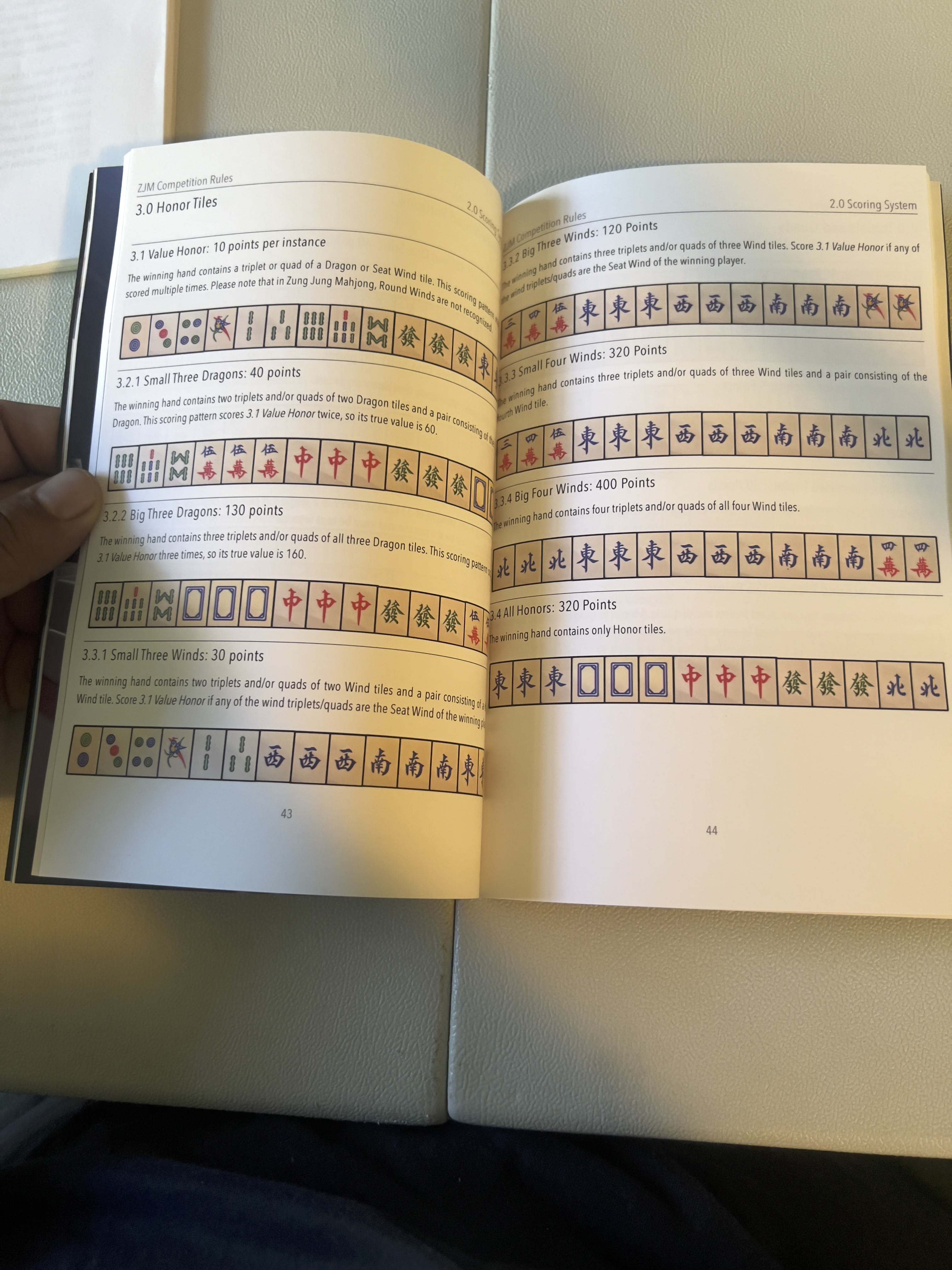
The winning hand contains a triplet or quad of a Dragon or Seat Wind tile. This scoring pattern may be scored multiple times. Please note that in Zung Jung Mahjong, Round Winds are not recognized.

3.2.1 Small Three Dragons
Point Value: 40
Description
The winning hand contains two triplets and/or quads of two Dragon tiles and a pair consisting of the third Dragon. This scoring pattern scores 3.1 Value Honor twice, so its true value is 60.

3.2.2 Big Three Dragons
Point Value: 130
Description
The winning hand contains three triplets and/or quads of all three Dragon tiles. This scoring pattern scores 3.1 Value Honor three times, so its true value is 160.

3.3.1 Small Three Winds
Point Value: 30
Description
The winning hand contains two triplets and/or quads of two Wind tiles and a pair consisting of a third Wind tile. Score 3.1 Value Honor if any of the wind triplets/quads are the Seat Wind of the winning player.

3.3.2 Big Three Winds
Point Value: 120
Description
The winning hand contains three triplets and/or quads of three Wind tiles. Score 3.1 Value Honor if any of the wind triplets/quads are the Seat Wind of the winning player.

3.3.3 Small Four Winds
Point Value: 320
Description
The winning hand contains three triplets and/or quads of three Wind tiles and a pair consisting of the fourth Wind tile.

3.3.4 Big Four Winds
Point Value: 400
Description
The winning hand contains four triplets and/or quads of all four Wind tiles.

3.4 All Honors
Point Value: 320
Description
The winning hand contains only Honor Tiles.

4.0 Triplets and Quads
4.1 All Triplets
Point Value: 30
Description
The winning hand consists of four sets of triplets and/or quads.

4.2.1 Two Concealed Triplets
Point Value: 5
Description
The winning hand contains two concealed triplets and/or quads. A triplet or quad completed by claiming a discard to complete the winning hand is not considered concealed for the purposes of this scoring pattern.
4.2.2 Three Concealed Triplets
Point Value: 30
Description
The winning hand contains three concealed triplets and/or quads. A triplet or quad completed by claiming a discard to complete the winning hand is not considered concealed for the purposes of this scoring pattern.
4.2.3 Four Concealed Triplets
Point Value: 125
Description
The winning hand contains four concealed triplets and/or quads. A triplet or quad completed by claiming a discard to complete the winning hand is not considered concealed for the purposes of this scoring pattern. This pattern always scores 1.2 Concealed Hand and 4.1 All Triplets, so its true value is 160.
4.3.1 One Quad
Point Value: 5
Description
The winning hand contains exactly one Quad.

4.3.2 Two Quads
Point Value: 20
Description
The winning hand contains exactly two Quads.

4.3.3 Three Quads
Point Value: 120
Description
The winning hand contains exactly three Quads.

4.3.4 Four Quads
Point Value: 480
Description
The winning hand contains exactly four Quads.

5.0 Identical Sets
5.1.1 Two Identical Sequences
Point Value: 10
Description
The winning hand contains two identical sequences in the same suit.

5.1.2 Pair of Two Identical Sequences
Point Value: 60
Description
The winning hand contains two instances of 5.1.1 Two Identical Sequences.

5.1.3 Three Identical Sequences
Point Value: 120
Description
The winning hand contains three identical sequences in the same suit.

5.1.4 Four Identical Sequences
Point Value: 480
Description
The winning hand contains four identical sequences in the same suit.

6.0 Similar Sets
6.1 Three Similar Sequences
Point Value: 35
Description
The winning hand contains three identically ranked sequences in all three suits.

6.2.1 Small Three Similar Triplets
Point Value: 30
Description
The winning hand contains two triplets and/or quads and a pair of equal rank.

6.2.2 Three Similar Triplets
Point Value: 120
Description
The winning hand contains three triplets and/or quads of equal rank.

7.0 Consecutive Sets
7.1 Nine-Tile Straight
Point Value: 40
Description
The winning hand contains three sequences of 123, 456, and 789 in a single suit.

7.2.1 Three Consecutive Triplets
Point Value: 100
Description
The winning hand contains three triplets and/or quads in a single suit and consecutively ranked.

7.2.2 Four Consecutive Triplets
Point Value: 200
Description
The winning hand contains four triplets and/or quads in a single suit and consecutively ranked.

8.0 Terminals
8.1.1 Half Outside Hand (Mixed Lesser Terminals)
Point Value: 40
Description
Each set and the pair in the winning hand contain at minimum one Terminal or Honor tile.

8.1.2 Full Outside Hand (Pure Lesser Terminals)
Point Value: 50
Description
Each set and the pair in the winning hand contain at minimum one Terminal.

8.1.3 All Terminals and Honors (Mixed Greater Terminals)
Point Value: 100
Description
The winning hand consists of only Terminals and Honor Tiles. This scoring pattern cannot be scored with 10.1 Thirteen Orphans.

8.1.4 All Terminals (Pure Greater Terminals)
Point Value: 400
Description
The winning hand consists of only Terminals.

9.0 Lucky Bonuses
9.1.1 Final Draw
Point Value: 10
Description
Winning on the Seabed Tile.
9.1.2 Final Discard
Point Value: 10
Description
Winning on the Riverbed Tile.
9.2 Win on Kong
Point Value: 10
Description
Winning on the Replacement Tile drawn from a Quad.
9.3 Robbing a Kong
Point Value: 10
Description
A player may declare Mahjong and win off of a tile that another player attempts to use to upgrade a melded triplet into a small melded quad.
9.4.1 Blessing of Heaven
Point Value: 155
Description
The East player wins off of their initial 14-tile hand. This pattern is always scored with 1.2 Concealed Hand, so its actual value is 160. This scoring pattern cannot be obtained if the East player melds a concealed quad from their initial hand and draws a replacement tile.
9.4.2 Blessing of Earth
Point Value: 155
Description
A non-East player wins off of East’s first discard of the round. This pattern is always scored with 1.2 Concealed Hand, so its actual value is 160. This scoring pattern cannot be obtained if the East player melds a concealed quad from their initial hand and draws a replacement tile.
10.0 Irregular Hands
No pattern in this category may be scored with 1.2 Concealed Hand
10.1 Thirteen Orphans
Point Value: 160
Description
The winning hand contains one of each Honor and Terminal tile and a duplicate of any of those tiles. The duplicate tile does not need to be the last tile of the hand.

10.2 Seven Pairs
Point Value: 30
Description
The winning hand contains seven pairs. The pairs do not have to be unique.

3.0 Tournament Format
3.1 Introduction
The Zung Jung Movement sanctions three tournament categories:
- Type 1 Tournaments: Single-day events intended for local clubs. It is structured as an accessible, community-oriented competition that promotes friendly rivalry and regular participation. It has three configurations:
- a standard configuration, a
- league configuration, and an online configuration played with Mahjong Hero.
- Type 2 Tournaments: Multi-stage, two-day events designed for higher-level competition. This format involves greater logistical coordination and is intended to attract strong players from multiple regions. It has two formats, the regional one also offered as an online configuration played with Mahjong Hero:
- a regional tournament intended to be organized by clubs, and an
- international tournament intended to be organized by the Zung Jung Movement itself.
- Type 3 Tournaments: Five single-day events organized into a season and involving eight teams of four players. It is designed to provide a team-play environment and a league format for people with time constraints.
All tournament configurations are derived from the structure of the 2015 World Series of Mahjong (WSoM) tournament, with modifications introduced by the Zung Jung Movement to better target each format to its intended demographics, improve portability, and reduce the logistical load on tournament organizers.
The Zung Jung Movement will not sanction Type 2 regional tournaments with fewer than 32 participants (see Section 3.2.1.2 Conditional Sanctioning for Type 2 Regional Events). A minimum of 32 players ensures that the preliminary round on the first day is meaningful. With 32 or more participants, at least half of the field will be eliminated during the preliminary round. If fewer than 32 participants are present, more players will advance to the final day than will be eliminated on the first day. For example, with 16 participants, all players would advance to the second day, making the preliminary round largely ceremonial.
Type 2 Tournaments require at least 16 participants for regional tournaments and 32 participants for international tournaments to maintain a properly structured elimination ladder. Type 3 tournaments must have eight teams of four people, no more and no less.
3.1.2 Overview of Tournament Formats
This section briefly outlines the formats offered by the Zung Jung Movement to help tournament organizers better understand them.
- Type 1 Standard: The baseline one-day tournament. A light, standalone weekend tournament designed to require minimal logistical effort from organizers. Designed as a starter tournament for players new to competition.
- Type 1 Season: Multiple Type 1 tournaments organized into a season. Offers a more competitive infrastructure while maintaining the Type 1 framework.
- Type 2 Regional: The baseline two-day tournament designed for serious Mahjong competition.
- Type 2 International: An international championship organized as a Type 2 tournament by the Zung Jung Movement or in partnership with an affiliated organization.
- Type 3 Team Season: A five-day team league for eight teams of four players. Each day, every team fields one player as its representative, so team members rotate in and out as the season progresses. The eight representatives play two sessions a day, at two tables of four, with seating rearranged between the sessions so that teams face different opponents. Each representative’s results count for their team. The fifth day is the final, and each team fields its best-performing member. (see Section 3.3.3, item 7)
- Online Configurations: Type 1 and Type 2 tournaments are also offered online, modeled after Type 1 Standard and Type 2 Regional respectively and played with the official ZJM game client Mahjong Hero (see Sections 1.9 and 3.4 for online timing).
3.2 ZJM Sanctioned Events
3.2.1 Sanctioning an Event
All tournaments organized through Mahjong Boss and overseen by a judge certified by the Zung Jung Movement (ZJM) through Mahjong Judge are automatically sanctioned by ZJM. Organizers using Mahjong Boss are not required to maintain formal affiliation with ZJM or submit separate applications for tournament sanctioning. By organizing a tournament through Mahjong Boss, organizers agree to comply with all applicable provisions of the Zung Jung Movement Official Rulebook (ZJMOR).
Organizations that do not use Mahjong Boss may also receive tournament sanctioning, provided they are formally affiliated with ZJM. To receive sanctioning, an affiliated organization must notify ZJM of the event in advance and affirm strict adherence to the ZJMOR as written. All sanctioned tournaments, regardless of the method of organization, must be overseen by a judge certified by ZJM through Mahjong Judge.
Tournament organizers generally operate their events independently and are responsible for their administration and compliance with ZJM regulations. ZJM reserves the right to send a qualified judge to any sanctioned tournament to ensure compliance with the ZJMOR.
Players, judges, or organizers who believe a sanctioned tournament has violated the ZJMOR are encouraged to report the matter to ZJM. Verified violations may result in disciplinary action, including the invalidation of tournament results, suspension of sanctioning privileges, or disaffiliation from ZJM where applicable.
ZJM reserves the right to revoke the sanctioned status of any tournament found to have violated the ZJMOR. Results from tournaments whose sanctioning has been revoked may be excluded from official ZJM rankings and competitive records.
3.2.1.1 Affiliating with the Zung Jung Movement
Affiliation with the Zung Jung Movement (ZJM) is open to Mahjong clubs, for-profit companies, nonprofit corporations, and other organizations dedicated to Mahjong. Organizations may obtain affiliation automatically through Mahjong Boss Premium or through a formal application to ZJM.
Automatic Affiliation through Mahjong Boss Premium
All clubs maintaining an active Mahjong Boss Premium subscription are automatically affiliated with ZJM for the duration of their subscription. No separate application or approval is required. By subscribing to Mahjong Boss Premium, clubs agree to support the growth and popularization of Zung Jung Mahjong and comply with the applicable provisions of the Zung Jung Movement Official Rulebook (ZJMOR).
Clubs that cancel or otherwise lose their Mahjong Boss Premium subscription automatically lose their affiliated status unless they have obtained affiliation through the formal application process.
Affiliation without Mahjong Boss Premium
Organizations that do not maintain a Mahjong Boss Premium subscription may apply for affiliation by contacting ZJM and formally expressing their intent to affiliate. Applicants must:
1. Affirm their commitment to the growth and popularization of Zung Jung Mahjong v3.3, as defined by Alan Kwan.
2. Provide a description of the program they will use to introduce, grow, and promote Zung Jung among players. Examples include Mahjong clubs hosting regular Zung Jung events or organizations incorporating Zung Jung tournaments into their existing tournament schedules.
ZJM reserves the right to approve or deny affiliation applications at its discretion.
Rights and Responsibilities of Affiliated Organizations
All affiliated organizations, regardless of their method of affiliation, are authorized to use official ZJM branding assets, including the ZJM logo, in connection with sanctioned tournaments and other approved Zung Jung activities.
Affiliated organizations are expected to promote Zung Jung Mahjong and uphold the standards established by the ZJMOR.
ZJM reserves the right to revoke an organization’s affiliation for violations of the ZJMOR or other conduct inconsistent with ZJM’s objectives. This authority applies to organizations affiliated through either method.
Tournament Promotion
ZJM will list sanctioned tournaments on its website’s Events page and promote them through the communication channels available to the organization.
3.2.1.2 Conditional Sanctioning for Type 2 Regional Events
Type 2 Regional tournaments require a minimum of 32 registered participants. Organizers may schedule and advertise a Type 2 Regional tournament before meeting this requirement, provided that a registration deadline is established.
If the tournament meets the minimum participant requirement by the registration deadline, it shall proceed as a sanctioned Type 2 Regional tournament.
If the tournament does not meet the minimum participant requirement, the organizer may choose one of the following alternatives:
- Reclassification: The tournament may be converted to a Type 1 tournament, provided it satisfies the applicable requirements of that format.
- Unsanctioned Tournament: The tournament may proceed under its originally planned format without ZJM sanctioning. Results from such tournaments shall not be recognized for official ZJM rankings or competitive records.
For tournaments organized without Mahjong Boss, affiliated organizations must coordinate with ZJM to establish the registration deadline and determine the tournament’s final classification.
Tournaments that meet the minimum participant requirement by the registration deadline shall not ordinarily lose their Type 2 Regional classification because of subsequent withdrawals. Minor reductions in participation will not affect classification, while substantial reductions may be subject to review by ZJM.
ZJM reserves the right to approve exceptions to these requirements when circumstances warrant.
3.2.2 Sanctioned Event Naming Conventions
Tournament organizers may select their own tournament names, provided those names do not misrepresent the tournament’s classification, sanctioning status, or relationship with the Zung Jung Movement (ZJM). Sanctioned tournaments may identify themselves as ZJM-sanctioned events in promotional materials. Organizers are encouraged to use the following designation:
A Zung Jung Movement-sanctioned Mahjong tournament.
The Zung Jung Movement reserves the exclusive right to organize or authorize tournaments under the title New World Series of Mahjong (NWSoM), either directly or in partnership with affiliated organizations. This title may not be used without explicit prior authorization from ZJM.
3.2.3 Tile-set Regulations
Tiles used in ZJM-sanctioned competition must conform to traditional Chinese or Japanese Mahjong visual conventions.
3.2.3.1 Suit Design
- Characters: must use standard Chinese numeral characters (e.g., character tiles must have the 1-9 Chinese numeric symbol on top and the 10,000 symbol (萬) on the bottom. For example, the 1 Character tile is represented by: 一萬).
- Bamboo: must depict stylized bamboo sticks in traditional Chinese arrangement, and the 1 Bamboo tile must feature an avian motif.
- Dots: must depict circular coin/dot motifs in traditional Chinese arrangement.
- Artistic reinterpretations of suits (e.g., abstract graphics, thematic objects, modern symbolic redesigns) are not permitted.
3.2.3.2 Honors
- Winds must be represented by the standard Chinese characters:
- East: 東
- South: 南
- West: 西
- North: 北
- Dragons must be represented by:
- Red: 中
- Green: 發 (or 発)
- White: four traditionally bordered tiles (Chinese style) or four blank tiles (Japanese style).
- Decorative reinterpretations of these tiles (e.g., icons, logos, or symbolic illustrations that replace characters) are not permitted.
3.2.3.3 Indices
- Small Arabic numerals and/or Latin letters are permitted for accessibility.
- Indices must not replace traditional suit artwork.
- Oversized indexing that materially alters tile aesthetics is not permitted.
3.2.3.4 Prohibited Designs
The following are not allowed in sanctioned play:
- Thematic or novelty tile sets
- Reimagined suit systems
- Graphic reinterpretations of tile faces
- Tiles resembling non-Mahjong objects or conceptual art sets
- Partially recolored tiles intended to denote bonus status (e.g., red 5 tiles used in some Japanese variants)
3.2.3.4.1 Color Application Standard
Color variation in the printed face artwork of a tile is permitted, including multi-color ink usage typical of traditional Chinese and Japanese sets (e.g., red, green, blue, or black elements within a suit design).
Such coloration is permitted provided that:
- It is part of the manufacturer’s original design and is applied uniformly to all copies of that tile type within the set;
- It does not designate gameplay status; and
- It does not cause any individual tile to differ in backing, edge color, shading, material, or finish from the rest of the set.
Differences in color that make a tile identifiable when face down are not permitted.
3.2.3.5 Consistency
All tiles at a table must:
- Be uniform in size and backing
- Be unmarked
- Follow the same design standard

3.2.4 Equipment Regulations
Competitive integrity in ZJM Competition Rules events depends on uniform playing conditions. Differences in table design, tile handling, or setup procedures can affect the pace of play, error rates, and the total number of hands completed in time-limited sessions. These factors directly influence scoring outcomes and player performance.
To eliminate equipment-driven variance, the ZJM Competition Rules define functional equipment classes and require that all competitors in a given competitive session play under materially equivalent conditions. Equivalence is determined by gameplay-relevant mechanics, not brand or cosmetic features.
This section establishes the classification framework and the requirements for equipment uniformity across all sanctioned events, ensuring that results are determined by player decisions rather than differences in equipment.
3.2.4.1 Equipment Classes
- Class A – Wall-Building Automatic Tables: tables that automatically shuffle tiles and construct full walls for play.
- A1 – Elevator tables: Walls are built internally and raised as complete walls.
- A2 – Rollercoaster tables: Walls are built and delivered via conveyor/track system.
- A3 – Auto-dealing tables: Walls are built and starting hands are automatically dealt.
- Class B – Tile-Dealing Automatic Tables: tables that do not construct walls and instead deliver tiles directly to players to draw.
- Class C – Manual Tables: tables with no automation; all tile handling is performed by the players


3.2.4.2 Equivalent Equipment Principle
- All time-limited competitive sessions must use a single equipment class. Equipment must be uniform for all competitors within a given session. For example, if one table uses a Class A1 autotable, all tables in that session must use Class A1 autotables.
- For Class A equipment, all tables must also match at the sub-class level (A1, A2, or A3). Mixing equipment classes or sub-classes within the same competitive session is prohibited.
- The Grand Final of Type 2 Regional and NWSoM is exempt from these restrictions, as it is conducted as a fixed-hand session (e.g., 16 rounds), where table speed does not affect the number of hands played. All finalists must compete under identical equipment and configuration within the Grand Final.
- Tile sets must be regulation (see Section 3.2.3). Organizers should standardize tile size and material across all tables within a competitive session where reasonably practicable. Mixing tile sizes across tables is permitted but discouraged in the interest of competitive rigor.
- All tables used in a competitive session must have uniform playing-surface dimensions, regardless of equipment class. Minor variations due to manufacturer tolerances are permitted, but significant differences in table size that could affect tile reach, wall spacing, or player ergonomics are prohibited.
3.3 Schedule Overview
3.3.1 Type 1 Tournaments
- ZJM Type 1 Tournaments will be 1-day events.
- The tournament is divided into 4 sessions of play.
- All players play all 4 sessions. Each player’s match point score (see Section 3.5.2 The Match Point System) from all 4 sessions is totaled, and at the end of the fourth session, their tournament rank is their match point ranking.
- In the unlikely event of a tie at prize-earning ranks (as determined by the tournament organizer), the tied players’ total raw scores across the 4 sessions are compared to determine which player(s) outrank the other(s). If the raw scores remain tied, the player will be selected at random.
3.3.2 Type 2 Tournaments
- ZJM Type 2 Tournaments will be 2-day events.
- For the regional format, the first day will have 4 sessions, and the second day will have 3 for a total of 7 sessions.
- For the international format, each day will be divided into 4 sessions of play, for a total of 8 sessions.
- The tournament consists of the preliminary round on the first day and the final rounds on the second day.
| Day 1 | Day 2 |
|---|---|
| Preliminary Round (4 Sessions) | Round 1 | Round 2 | Semi-Finals | Grand Final |
3.3.2.1 The Preliminary Round
- The preliminary round consists of 4 sessions of play on the first day of the event.
- All players play all 4 sessions. Each player’s match point score from all 4 sessions is totaled, and the top
- 16 players with the highest match point totals advance into the final-day rounds of regional tournaments
- 32 players with the highest match-point totals advance to the final-day rounds of international tournaments.
- In the unlikely event of a tie at 16th place for regionals or 32nd place for internationals, the tied players’ total raw scores across the 4 sessions are compared to determine which player(s) advance to the final-day rounds. If the raw scores remain tied, the advancing player will be chosen at random.
3.3.2.2 Final Day Rounds
- The final rounds are held on the second day. A total of three rounds are played in regional tournaments and four in international tournaments, with each round consisting of a single session.
- The top 16 or 32 players from the preliminary round will enter the first round on the final day for regional and international tournaments, respectively.
- After each round, players are ranked by their raw session scores; the Match Point (MP) system (see Section 3.5.2 The Match Point System) is not used to determine elimination or advancement during this phase. The bottom half of the standings is eliminated, and the top half progresses to the next stage.
- If the organization maintains a running leaderboard, see Section 3.5.2.1 Leaderboard Systems; MPs are calculated for leaderboard purposes but not tournament advancement.
- In the event of a tie in the session score at the cut-off rank, the player with the higher MP score from the preliminary rounds on the first day will advance. If this is also tied, the advancing player will be selected at random.
| final day round # | 1 | 2 | 3 | Final |
|---|---|---|---|---|
| # of players | 32 | 16 | 8 | 4 |
| # advance | 16 | 8 | 4 |
Players should note that, in general, the total scores of all players in a session should sum to zero, since the winner’s points are taken from the other players. As a result, roughly half of the players have positive scores, and the other half have negative scores. Accordingly, even a small positive score may be sufficient for advancement, though this is not guaranteed. Taking reckless risks in pursuit of large scores is more likely to result in elimination than advancement, unless a player is already significantly behind and must recover ground.
3.3.3 Type 3 Tournaments
- ZJM Type 3 Tournaments will be 5-day events.
- The days do not need to be organized consecutively.
- Each tournament day consists of two sessions of play, for a total of ten sessions across the five-day tournament.
- There are eight teams consisting of exactly four players.
- Each player on a team plays 2 sessions for their assigned day and rotates their seat with a teammate for the next day of the tournament.
- Each player’s match point score from both sessions is totaled, and at the end of the second session, their result is applied to their team’s match point score.
- On the fifth day, each team fields its best-performing member. A member’s performance is their total match points from the sessions they played on days one through four. Ties are broken in this order: higher total raw score, better average table placement, fewer sessions played, then a draw.
3.4 Sessions
3.4.1 Type 1 Tournaments
3.4.1.1 Type 1 Session Structure
- Each session will be played to the time limit with a maximum of 8 rounds (2 cycles) for in-person tournaments and 16 rounds (4 cycles) for online tournaments. Each cycle consists of four rounds, and the deal passes after every round.
- Each player starts each session with 0 points. The scores (plus or minus) from each round alone constitute one’s result for the session; there are no additional bonus points for one’s rank at the table or similar adjustments.
- The organizer will randomly assign players to tables at the beginning of each session. A seating slip will be issued to each player indicating the correct table.
- At the start of the first cycle of the session, the 4 players at a table will randomly determine their seating order. These will be the players’ seats for the entire session.
- At the end of each session, there will be a break before the next session. The length of the break will be defined by the schedule designed by the tournament organizer.
3.4.1.2 Type 1 Session Time Limits
- The session time limit will be 60 minutes.
- A player who does not show up after break time ends will be considered late and penalized accordingly.
- At the end of the session, all players still playing must immediately put down their tiles and stop play, even if they are in the middle of a round. Any unfinished round is considered over and may not be completed. Handling tiles after the session end time will result in penalties.
- For the time limits for each player’s playing time in a hand, please see Section 1.9 Play Time Limits.
- A player who is leading in score may not deliberately take a time-out or exceed the play time limit in order to reduce the number of rounds played and protect the lead. If the judges suspect such behavior, they will impose a scoring penalty.
3.4.2 Type 2 Tournaments
3.4.2.1 Type 2 Session Structure
- In each session, four cycles (16 rounds) of Mahjong will be played, unless play is truncated by the time limit. Each cycle consists of four rounds, and the deal passes after every round.
- Each player starts each session with 0 points. The scores (plus or minus) from each round alone constitute one’s result for the session; there are no additional bonus points for one’s rank at the table or similar adjustments.
- During the preliminary rounds, the organizer will randomly assign players to tables at the beginning of each session. A seating slip will be issued to each player indicating the correct table.
- At the start of the first cycle of the session, the 4 players at a table will randomly determine their seating order.
- At the start of the second cycle, the East and South players will exchange seats, and the West and North players will do the same.
- At the start of the third cycle, the East player crosses the table to become West, and the South player crosses the table to become North. The North player rotates into the East seat, and the West player rotates into the South seat.
- At the start of the fourth cycle, the East and South players will exchange seats, and the West and North players will do the same.
- After swapping seats, the player in the East seat will become the starting East for the new cycle.
- At the end of each session, there will be a break before the next session. The length of the break will be defined by the schedule designed by the tournament organizer.

3.4.2.2 Type 2 Session Time Limits
- For the preliminary round and the final-day rounds 1 and 2, the session time limit will be 90 minutes for regional tournaments and 120 minutes for rounds 1, 2, and 3 in international tournaments. Online tournaments follow the regional format and have a session time limit of 60 minutes for the preliminary round and final-day rounds 1 and 2.
- There is no session time limit in the Grand Final, including in online tournaments; the full 16 rounds will always be played. Per-round play time limits still apply.
- A player who does not show up after break time ends will be considered late and penalized accordingly.
- At the end of the session, all players still playing must immediately put down their tiles and stop play, even if they are in the middle of a round. Any unfinished round is considered over and may not be completed. Handling tiles after the session end time will result in penalties.
- For the time limits for each player’s playing time in a hand, please see Section 1.9 Play Time Limits.
- A player who is leading in score may not deliberately take a time-out or exceed the play time limit in order to reduce the number of rounds played and protect the lead. If the judges suspect such behavior, they may require the full number of rounds to be played regardless of the time limit or impose an additional score penalty.
3.4.3 Type 3 Tournaments
3.4.3.1 Type 3 Session Structure
- Each session will be played to the time limit with a maximum of 8 rounds (2 cycles). Each cycle consists of four rounds, and the deal passes after every round.
- Each player starts each session with 0 points. The scores (plus or minus) from each round alone constitute one’s result for the session; there are no additional bonus points for one’s rank at the table or similar adjustments.
- The eight representatives are assigned to two tables of four at the start of each session. Assignments are not drawn at random: they are chosen so that, across the season, any two teams meet as evenly as possible, and any repeat meeting is placed as far from the previous one as possible. The second session of a day uses a different grouping from the first. A seating slip will be issued to each representative indicating the correct table.
- At the start of the first cycle of the session, the 4 players at a table will randomly determine their seating order. These will be the players’ seats for the entire session.
- At the end of each session, there will be a break before the next session. The length of the break will be defined by the schedule designed by the tournament organizer.
3.4.3.2 Type 3 Session Time Limits
- The session time limit will be 60 minutes.
- A player who does not show up after break time ends will be considered late and penalized accordingly.
- At the end of the session, all players still playing must immediately put down their tiles and stop play, even if they are in the middle of a round. Any unfinished round is considered over and may not be completed. Handling tiles after the session end time will result in penalties.
- For the time limits for each player’s playing time in a hand, please see Section 1.9 Play Time Limits.
- A player who is leading in score may not deliberately take a time-out or exceed the play time limit in order to reduce the number of rounds played and protect the lead. If the judges suspect such behavior, they will impose a scoring penalty.
3.5 Tournament Ranking
ZJM Competition Rules tournaments prioritize achieving a positive score over relative table placement, as emphasized in many other competitive formats. Players should calibrate their strategic decisions with this distinction in mind.
3.5.1 Recording and Reporting Scores
- After each session, the organizer will post the results once the score has been calculated.
- Players should keep track of their own score records during the session.
- If a player suspects an error in their score, they may request a score check.
- Posted results are subject to correction. The final posted version is considered official.
- After the event concludes, the organizer will publish the final rankings. For Type 1 Tournaments and for players who do not advance to Day 2 of Type 2 Tournaments, rankings are determined by the total match points accumulated. For the final day of Type 2 Tournaments, rankings are determined by raw point totals within each player’s elimination bracket. For example, Player Rank 16 (regional tournament) is the lowest-scoring player among the first group eliminated, while Player Rank 1 is the winner of the Grand Final session.
3.5.2 The Match Point System
The match point (MP) system is designed to reward consistent, disciplined play that reliably generates positive results over time. This system is adopted as the placement scoring system for Type 1 Tournaments and for the preliminary round of Type 2 Tournaments. High-variance strategies that rely on occasional large wins but more often yield negative returns are disincentivized. This is how the system works:
- A player’s match point score for a session is the square root of their raw score. If a player has a negative score, the square root of its magnitude is applied, and the result is multiplied by -1.
- A player’s score at the end of each session is converted to match points and then added to their running score.
| raw score | +400 | +300 | +200 | +100 | +50 | 0 | -50 | -100 | -200 |
| match point | +20 | +17.3 | +14.1 | +10 | +7.1 | 0 | -7.1 | -10 | -14.1 |
3.5.2.1 Leaderboard Systems
- The MP system shall be used to determine standings in any Zung Jung leaderboard system maintained by a ZJM Affiliate.
- ZJM Affiliates may include only sanctioned events in their leaderboard standings. Inclusion of unsanctioned events is strictly prohibited.
- Player standings in time-windowed leaderboards (e.g., seasonal, annual) shall be calculated as the sum of MP scores earned within the applicable window.
- Lifetime leaderboard standings shall be calculated using the Glicko-2 algorithm and is supplied to each organization registered in ZJM’s Club Directory. ZJM maintains lifetime leaderboards and the level above clubs, including but not limited to global, regional, and city-level boards.
- If time-windowed leaderboards are maintained alongside a lifetime leaderboard, the lifetime leaderboard shall include all qualifying events across all applicable time windows.
3.5.3 Bracket Seeding and Reseeding for the Final Day of the Type 2 Tournaments
3.5.3.1 Governing Principle
The elimination phase of Type 2 tournaments uses full reseeding after each elimination round, subject to structural separation constraints that preserve the integrity of the top seed.
Preliminary round ranking is the sole seeding authority for the entire elimination phase of Type 2 tournaments and assigns each player their initial seed for the first round of the final day. Each player’s initial seed corresponds to their rank from the preliminary round.
| Table # | Seed # | Seed # | Seed # | Seed # |
|---|---|---|---|---|
| 1 | 1 | 16 | 17 | 32 |
| 2 | 5 | 12 | 21 | 28 |
| 3 | 3 | 14 | 19 | 30 |
| 4 | 6 | 11 | 22 | 27 |
| 5 | 7 | 10 | 23 | 26 |
| 6 | 4 | 13 | 20 | 29 |
| 7 | 8 | 9 | 24 | 25 |
| 8 | 2 | 15 | 18 | 31 |
3.5.3.2 Reseeding Procedure After Each Elimination Round
After completion of each elimination round:
- All advancing players shall be listed.
- Players shall be sorted in ascending order by their original preliminary round rank and assigned a seed number based on their position on the list.
- No other metric may be used for reseeding.
| Player Day 1 MP Rank | Seed # | Bracket (Table #) |
|---|---|---|
| 1 | 1 | 1 |
| 2 | 2 | 4 |
| 4 | 3 | 2 |
| 6 | 4 | 3 |
| 7 | 5 | 3 |
| 9 | 6 | 2 |
| 10 | 7 | 4 |
| 12 | 8 | 1 |
| 13 | 9 | 1 |
| 15 | 10 | 4 |
| 17 | 11 | 2 |
| 19 | 12 | 3 |
| 20 | 13 | 3 |
| 23 | 14 | 2 |
| 26 | 15 | 4 |
| 29 | 16 | 1 |
3.5.3.3 Structural Separation Constraints
The following invariants must be preserved at every reseed:
Seed #1 and Seed #2
Seed #1 and Seed #2 shall be placed in opposite halves of the bracket and may not meet prior to the Grand Final.
Seeds #1–#4
Seeds #1–#4 shall be distributed such that:
- #1 and #4 are placed in opposite semifinal groups.
- #2 and #3 are placed in opposite semifinal groups.
- No two of the seeds #1–#4 may share a table prior to the Semifinal stage.
General Rule
Higher-ranked players shall be distributed so as to prevent early convergence of the strongest remaining seeds whenever mathematically possible.
3.5.3.4 Table Formation Method
After applying structural separation:
- Remaining players shall be divided into equal bracket halves.
- Within each half, players shall be distributed into tables using quartile compression:
For each table:
- The highest-ranked remaining player in that half
- Lowest-ranked remaining player in that half
- Corresponding player from the upper-middle group
- Corresponding player from the lower-middle group
This ensures:
- One extreme pairing per table (strongest vs weakest)
- Middle-ranked competitive density
- Balanced advancement pressure
| Table # | Seed # | Seed # | Seed # | Seed # |
|---|---|---|---|---|
| 1 | 1 | 8 | 9 | 16 |
| 2 | 3 | 6 | 11 | 14 |
| 3 | 4 | 5 | 12 | 13 |
| 4 | 2 | 7 | 10 | 15 |
| Table # | Seed # | Seed # | Seed # | Seed # |
|---|---|---|---|---|
| 1 | 1 | 4 | 5 | 8 |
| 2 | 2 | 3 | 6 | 7 |
| Table # | Seed # | Seed # | Seed # | Seed # |
|---|---|---|---|---|
| 1 | 1 | 2 | 3 | 4 |
3.5.3.5 Upset Handling
If a higher seed is eliminated:
- The advancing lower seed inherits no protected position.
- Reseeding is conducted strictly according to the original preliminary round ranking.
- Structural invariants remain binding.
No bracket slot is preserved.
3.5.3.6 Design Intent
This format ensures:
- Preliminary performance materially affects the difficulty of the elimination phase.
- No bracket path becomes artificially soft due to upsets.
- Variance is locally contained.
- Winning requires repeated superiority across multiple reseeded rounds.
- The strongest players are structurally prevented from premature collision.
3.5.4 Type 3 Team Ranking
- A team’s score is the sum of the match points (see Section 3.5.2) earned by its representatives in every session of the tournament, including the fifth-day final. The final is scored in the same way as the other days and does not reset the team standings.
- Teams are ranked by team score. Ties are broken in this order: higher total raw score earned by the team’s representatives, better average table placement, then a draw.
- A Type 3 Tournament publishes a team leaderboard only. There is no individual leaderboard.
- If a team’s scheduled representative cannot play, the team fields another member of its roster in their place. If no member of the team is available, the team receives a penalty of 15 match points for each session missed.
- Each team’s roster consists of exactly four players and is fixed at registration. The organizer may approve a replacement for a roster member before the first day of the tournament. Section 3.6 Player Teams does not apply to Type 3 Tournaments.
3.6 Player Teams
- Tournament organizers may choose to allow players to register as teams.
- For Type 1 Tournaments and the preliminary round of Type 2 Tournaments, players who are family members, close friends, or otherwise associated may choose to register as a team at the organizer’s discretion. Please refer to your tournament organizer’s registration instructions.
- During table assignment for Type 1 Tournaments and the preliminary round of Type 2 Tournaments, the organizers will attempt to place team members at different tables. This allows them to compete freely without risking their teammates’ rank. Team membership is not considered during table assignments in the final day.
- Players may be registered as a team only with the consent of all team members.
- A team is limited to a maximum of 4 players for Type 1 Tournaments and 8 players for Type 2 Tournaments.
- Team composition may be added or changed at any time up to the day before the event begins.
- The organizers will attempt to place team members at different tables, but this is not guaranteed.
3.7 Special Pardons for Late Arrivals
To account for the possibility that a player’s travel to the venue may be delayed by external circumstances, players may join the tournament in a later session. The rules in this section take precedence over those in other sections.
- A registered player who is absent for the first one or two sessions of a Type 1 Tournament or preliminary round of a Type 2 Tournament, but checks in with the organizer before the start of the third session, will be allowed to participate in the tournament thereafter.
- For each session the player is absent, a penalty of 15 match points (MP) will be deducted from the player’s result.
- The organizer may refuse to allow a player to participate in a session if they check in less than 10 minutes before the session starts.
- The above rules apply only to Type 1 Tournaments and the first sessions of the preliminary round of Type 2 Tournaments. A player who has participated in one or more sessions but is absent in a later session without an acceptable reason (as determined by the organizer) will be eliminated for resignation; the player may not request that the point penalty be applied instead.
4.0 Code of Conduct
4.1 Overview
- The basic principles outlined in the Overview section also apply to this chapter. In particular, players should note the Player Enforcement Principle.
- The latest version on the Zung Jung Movement official website should be considered the authoritative version of these rules.
4.2 General Code of Conduct
- Players must treat each other with respect, regardless of skill level, background, or personal differences.
- Discriminatory or offensive language, including but not limited to remarks about race, gender, age, or ability, will not be tolerated.
- Harassment, bullying, or any form of intimidation is strictly prohibited.
- Players must not act in any manner that violates the spirit of fair competition.
- Players should accept wins and losses graciously, without gloating or blaming others.
- Players should always play to the best of their ability. Collusion with another player and/or intentionally harming one’s own competitive interest is prohibited. Communicating the contents of one’s hand (other than tiles that are legally exposed) to another player is also prohibited. A player who is behind in score and has little chance of advancement must still demonstrate sportsmanship by continuing to play to the best of their ability.
- Any form of intentional cheating is strictly prohibited. This includes, but is not limited to, hiding tiles on one’s body, illegally swapping tiles, stacking the Wall tiles in an unfair manner, or falsely reporting scores.
- Players must not obstruct the smooth running of the competition. Players must follow the judges’ instructions; any appeals must be submitted in a civil manner.
4.3 Appeals
- If a player believes there are sufficient grounds to dispute a judge’s ruling, the player may explain the reason at the time the ruling is made.
- If the player still disagrees with the judge’s ruling after this, the player should not argue with the judge but should submit an appeal to the head judge during the break between the end of the session in question and the player’s next session.
- The head judge’s decision on all matters is final. No further objections will be considered.
- For score checking requests, please see Section 3.5.1 Recording and Reporting Scores.
4.4 Apparel & Manners
- Players should be dressed neatly and appropriately. Players must not wear reflective clothing (including reflective buttons), glasses, or accessories that could allow opponents to see their hand tiles.
- The organizer reserves the right to require a player to cover or remove any trademarks, slogans, logos, or similar markings displayed on their apparel.
- During the competition, any bags or handbags must be placed under the chair. Players may keep their wallets and identification documents on their persons. Players are responsible for safeguarding their own belongings; the organizer is not responsible for any loss.
- Players should behave courteously toward other players, judges, and officials.
4.5 Electronic Equipment
- During play, players may not use electronic or communication devices, such as mobile phones, PDAs, or laptops. When play begins, players must switch off such devices, place them in sleep mode, and disable any ringtones. Penalty points will be deducted if a device rings during play.
- During score computation at the conclusion of a hand, players may use the following tools to assist with scoring:
- A simple calculator, or the calculator function of a mobile phone, tablet computer, etc.
- An application program (on a smartphone, tablet computer, or similar device) that allows the player to manually select from a list the scoring patterns applicable to the hand. The program should include functionality to display the selected patterns so that all players can see them. The program may automatically total the scores of the selected patterns and calculate the payoff for the four players.
- It is prohibited to use a program that automatically determines applicable scoring patterns based on the tiles in the winning hand, whether through manual entry or by photographing them.
4.6 Player Obligations
- By participating in the competition, the player grants the organizer permission to record their image and voice. The organizer may broadcast or publish such recordings.
- For Type 1 League Configuration and Type 2 Tournaments, players must comply with the organizer’s request for an interview. A player who refuses to be interviewed may receive a point penalty. However, if a player has a reasonable excuse that an interview at that moment could affect their performance in the competition (such as illness or time pressure), the player may request that the interview be postponed, no later than after the player has completed all play in the competition.
- The judge may require a player to testify about what they have seen or heard. The player has an obligation to provide truthful testimony. A player who deliberately gives false testimony in order to undermine the fair and just rulings of the judge will be subject to severe penalties, up to and including disqualification and blacklisting.
- Players are responsible for familiarizing themselves with the scoring patterns before the tournament.
4.7 Health
- Maintaining one’s health and fitness to participate is the player’s responsibility. The organizer shall not be liable for any health problems (including illness, injury, or death) that arise during or as a result of participation in the tournament.
- Players should not consume excessive amounts of intoxicants before or during the event. Players are responsible for their behavior at all times. Any misconduct by an intoxicated player will be penalized accordingly.
- Shuffling Mahjong tiles may produce noise. Players who are sensitive to noise are advised to bring their own earplugs if needed.
- Players with a physical disability should inform the organizer during registration so that appropriate accommodations can be prepared.
4.8 Play Ettiquette
- No chatting is allowed during play, except for the required verbal announcements for claims. Players must verbally announce claims, including declarations of “mahjong” or “kong”; an unvoiced claim has no precedence, and opponents may ignore it and continue play.
- Players may make brief comments or engage in short discussions between rounds, but they should avoid speaking loudly or disturbing nearby games in progress.
- While the shuffling of tiles may naturally produce noise, players must not create unnecessary noise during the deal or play by striking the tiles hard against the table. However, it is permitted to knock the winning tile once as a normal emotional expression.
- Players may not leave their seats or stand up during the middle of a round.
- During play, if a player needs to access belongings under the chair or retrieve an item dropped on the floor, the player must first notify a judge and may bend down only under the judge’s supervision. During play, players may not access or use any electronic or communication device, such as a mobile phone.
4.9 Scoring Card
- Each table will be issued one Official Scoring Card (see Appendix A.2.2) for each session
- The judge fills in the Official Scoring Card for the players. However, players who know how to use the Official Scoring Card may fill it in themselves.
- When recording scores on the Official Scoring Card, each round’s scores should be recorded directly rather than added together. Scores should only be added together at the end of the session.
- Any writing on the Official Scoring Card must be done openly on the table, not on one’s lap. Please write carefully; any corrections must be verified and signed by a judge.
- After the scores for each hand have been recorded on the Official Scoring Card, players should verify that the scores have been recorded correctly before starting the next round.
- At the end of a session, the players should sign the Official Scoring Card in the designated spaces after verifying that the scores have been totaled correctly. Players should remember to complete this step of checking and signing; once the card has been submitted to the organizer for tallying, it may become impossible to correct any errors.
4.10 Seating
- Players should enter the event hall at least 10 minutes before the session’s scheduled start time.
- Each player will receive a seating slip indicating the player’s table number. The player must report to the assigned table on time.
- After a cycle, the players exchange seats.
- After rotating tables, players must not disclose their previous opponents’ results to their new opponents, nor provide detailed information about their own previous results. Players should also refrain from asking their opponents for such information.
4.11 Penalties
The different classes of penalties are summarized below. The judge determines the type and terms of a penalty. The head judge has the final decision.
- Disqualification & Blacklisting: A player may be disqualified from the competition for intentional cheating, collusion, or any deliberate offense that seriously disrupts the competition’s operation. In serious cases, the player may also be blacklisted from participating in the event. A disqualified player is not eligible for any prizes, and their entry fee will not be refunded.
- Resignation: A player who does not complete the required play, for example, due to absence or early departure, will be eliminated from the tournament.
- Dead Hand: A player may be prohibited from winning in the current round. This penalty is applied when an irregularity occurs that renders the hand ineligible to be completed as a winning hand, such as an improperly displayed set or a hand containing too many or too few tiles.
- No Claims: A player may be prohibited from claiming any discards for any purpose during the current round. This penalty may be applied for a dead hand or when a player inadvertently exposes or sees an opponent’s hand tiles.
- Penalty Points: A score penalty may be imposed for various offenses, such as exceeding the play time limit or repeatedly failing to verbally announce claims. In most cases, the penalty is deducted from the player’s total score and is not credited to the opponents. An exception may be made for serious offenses that undermine an opponent’s opportunities, such as disruption or abortion of the game.
- Penalty Tiles: See Section 1.7 Penalty Tiles. This penalty primarily addresses illegally exposed tiles and is intended to prevent a player from benefiting from information about another player’s hand being revealed, whether through collusion or a tactical alliance.
- Warning: For minor violations (such as failing to verbally announce a claim), the judge may issue a warning. Repeated violations may result in a more severe penalty.
- Correction: For certain violations, the judge may correct the irregularity or grant relief to another player in order to maintain the fairness of the competition. For example, if a player deliberately draws two tiles to prevent the lower seat from taking the seabed tile, the judge may allow the lower seat the opportunity to draw one tile.
4.12 Collusion v.s. Tactical Alliance
- Each player should play for themselves, aiming to achieve the best possible score and ranking.
- Colluding with another player(s) to influence the outcome of the game is prohibited. Examples include:
- A clear or repeated pattern of behavior indicating that a player is intentionally acting against their own competitive interest to benefit another player.
- A clear or repeated pattern of behavior indicating that a player is intentionally abandoning competitive play or is attempting to throw the game.
- Evidence of collusion includes, but is not limited to:
- Communicating concealed hand information, whether directly or through coded signals.
- Coordinating discards or other actions to influence or manufacture the outcome of a game.
- Recklessly discarding in a repeated pattern that consistently benefits a single player at the table.
- Reckless discarding in a repeated pattern when a player is behind in the table score, indicating that the player is deliberately not playing to the best of their ability.
- During play, a situation may arise in which an opponent threatens a high-scoring hand. In such cases, a player may deliberately discard a winning tile to allow another opponent to complete a smaller hand in order to avoid a larger loss. This strategy, known as a tactical alliance, is permitted because it serves the player’s competitive interests: losses are shared equally with the other two losing players for small hands (≤25 points), in accordance with Section 2.3 The Payoff Scheme.
- Tactical alliances may be supported with the following evidence:
- The threat of the high-scoring hand must be reasonable based on visual information.
- The winning hand appears small based on visual information.
- The player’s own hand is small or unlikely to win.
- There may be situations in which an opponent clearly threatens a high-scoring hand while a player is developing a high-scoring hand of their own, with a strong chance of winning. In such cases, the player may choose to risk discarding dangerous tiles rather than abandoning their own opportunity. This is considered legitimate risk-taking.
- Players who have accumulated a negative score in the round and are likely to end the tournament with a low rank and/or be eliminated must still play to the best of their ability.
4.13 Voluntary Withdrawal
- Toward the end of a Type 1 tournament or preliminary round of a Type 2 Tournament, a player may voluntarily withdraw.
- A player who voluntarily withdraws is considered to have resigned and is not eligible for any prizes, regardless of the results achieved up to that point.
- A player who wishes to voluntarily withdraw should report this intention to the organizer as soon as possible.
4.14 Time-Outs
- Late arrivals: A player who arrives late will receive a point penalty equivalent to taking a time-out for the duration of the delay, without the 180-second grace period (see next item). A player who is more than five minutes late may be considered absent and may either be eliminated for resignation or penalized an arbitrary number of points, not less than that specified in the next item.
- Time-outs: A player who needs to leave the table before the session ends must obtain permission from the judge. Players are allowed a cumulative time-out of up to 180 seconds per session without penalty. Additional time beyond this allowance incurs a penalty of 5 points for every 30 seconds, or part thereof.
- A time-out may typically only be taken between rounds. Time-outs during a round are not permitted except in cases of emergency.
- When a player takes a time-out, the other three players must remain at the table. Any player who leaves the table will also be considered to be taking a time-out and will be penalized accordingly.
- A player may take a short time-out of up to 60 seconds without penalty to take medication, provided that a doctor’s notice confirming the necessity of timely administration has been submitted in advance. In all other cases, including medical reasons, the judges reserve the right to impose the aforementioned time-out penalties.
- Tournament organizers and judges may choose to modify or waive the grace period and/or penalty, depending on the circumstances of the event and venue; for example, a location may not have a readily accessible restroom, requiring contestants to travel a distance to reach one. The above provisions are intended as guidelines to assist organizers in structuring fair competition and administering time-outs. Any modifications made by organizers must apply equally to all tournament contestants.
4.15 Absentee Policy
- A player who fails to report to their table within five minutes after the start of the session may be considered absent and may be eliminated from the competition for resignation or subject to a number of penalty points determined by the judge. If a player anticipates an emergency that may cause a brief delay beyond five minutes, the player should inform the head judge in advance; in such cases, the penalty may be reduced to that specified under the “Time-outs” provision above.
- If a player becomes aware that they will be unable to participate in a future round due to an emergency, the player should notify the organizers as soon as possible.
- The organizers may designate neutral players to fill empty seats at a table or make last-minute adjustments to table assignments for the same purpose. This will normally occur only during Type 1 Tournaments or the preliminary round of Type 2 Tournaments, as the highest-ranked eliminated player present will typically be called to fill such seats during the final day rounds of Type 2 Tournaments.
5.0 Tournament Organizer Parameters
Because the ZJM Competition Rules are designed to serve as a portable tournament standard, certain event-specific parameters cannot be fully specified in this document. Tournament organizers are responsible for determining the following matters, as well as any other items not explicitly addressed in the ZJM Competition Rules:
- Entry fee
- Prize structure
- Payout distribution
- Sponsorship agreements
- Venue
- Schedule timing
- Registration cap
- Food/break logistics
- Media/streaming decisions
- Practice Games
Appendix
A.1 Version Changelog
Version 1.0.1
Item 6 in 4.8 Play Ettiquette has been removed. The language stated:
If a player makes any suspicious movements during play, a body search may be conducted to verify that no rules have been violated. Any such search will be conducted by a person of the same sex as the player.
This was removed for two reasons:
- It may difficult to have a diverse gender staff for small clubs that have limited resources and few organizers
- More importantly, it was brought to the attention of the Zung Jung Movement that the clause could be interpretted in a way that could make trans participants feel unsafe, e.g., it could be interpreted that a cis woman should inspect a trans man
The goal of the Zung Jung Movement is to provide a ruleset where every participant can enjoy the Mahjong, so the clause is removed. It is up to the tournament organizer to determine how they would like to handle the issue of a player potentially hiding tiles on their person. This issue should be handled with respect toward the participant. The individual who brought attention to this clause suggested the following language change to the clause and it is presented here as advisement:
If a player makes any suspicious movements during play, a body search may be conducted to verify that no rules have been violated. Any such search will be conducted by a person of the same gender as the player.
Version 1.1
Thomas Bress helped to edit and make corrections and clarifying changes to the document. These are the changes made:
- Minor spelling, punctuation, and grammar corrections.
- Removed bullet 6 from 1.1.1 The Mahjong Tiles and put its content into bullet 4.
- Sentence added for clarity in 1.1.4 Set Definitions bullet 1: “A sequence must be strictly consecutive, 8-9-1 and 9-1-2 are not valid sequences.”
- Accepted Bress’ suggestion to remove the sentence “The other winds are called Guest Winds” from 1.2.3 Seat Winds, bullet 2, as it is the only time the term appears in the document.
- Deleted the sentence “Count the last seven stacks left of the break point and split them from the rest of the wall. “ from 1.2.5 Breaking the wall, bullet 2, for clarity. Bress’ commentary provided in the sub-bullet
- This rule is suggesting that you break off the dead wall before the game begins. However, 1.6 bullet 2 reads “Late in a round, any player may request that the wall breaker push the 14-tile Dead Wall slightly to the left to separate it from the live wall, making it easier to see how many tiles remain.”. I believe that breaking the dead wall off late in the game is the way that Alan Kwan suggests in his rule set. Either way, the highlighted sentence conflicts with 1.6 2) and the conflict should be resolved. I suggest just deleting this sentence and continuing with “The stacks to th eleft of the split become the Live Wall…”
- Sentence “The tiles shall be reshuffled and the dice re-cast” in 1.2.7 Tile Dealing Errors, bullet 7, changed to “The tiles shall be reshuffled and the dice re-cast without rotating the Seat Winds” for clarity.
- Changing 1.3.2 Rules for Drawing and Discarding, bullet 9 from “Players shall not announce the identity of a discarded tile. If a player misidentifies a discard and causes an opponent to make an incorrect claim, the offending player shall be penalized” to “Players are not required to announce the identity of a discarded tile. If a player announces a discarded tile and misidentifies it causing an opponent to make an incorrect claim, the offending player shall be penalized.”
- Removed the sentence “The tiles must be arranged in numerical order from left to right.” from 1.4.2 Calling Chi, bullet 2. This is a holdover from the original WSoM rules that snuck through the original editing process.
- Added Figure reference to 1.4.2 Calling Chi, bullet 3.
- Added sub-bullet “If one attempts to upgrade a melded triplet to a small melded quad, that tile may be claimed by another player to complete their winning hand (see Section 1.4.4 Robbing a Kong).” to 1.4.3 Calling Kong, bullet 3 Small Melded Quad
- Changed the sub-bullet in 1.4.3 Calling Kong, bullet 4 Big Melded Quad from “The player then draws a replacement tile” to The player then draws a replacement tile. Play then continues with the player in the lower seat, who takes the next turn and draws a tile.
- Moved bullet 5 in 1.4.3 Calling Kong to a sub-bullet in 1.4.3 Calling Kong, bullet 3 Small Melded Quad.
- Removed the sentence “There is a scoring limit of 320 points” from 2.2 Basic Scoring Rules, bullet 6 as it is redundant.
- Changed “Fixed Income Principle” to “Fixed Payoff Principle” in2.3 The Payoff Scheme, bullet 1.
- Updating the description of the pattern 2.2 Nine Gates from “The hand, ready to win, is concealed and contains exactly 1112345678999 in a single suit. The winning hand is completed by completing a pair in this specific ready hand. The structure of the ready hand allows it to complete its Pair with any rank of tile in its suit. “ to “The winning hand consists of 1112345678999 in a single suit plus one duplicate of any of these tiles. The duplicate must be the last tile and must be kept separate from the rest of the hand. This hand must be played concealed.”
- Added a clarifying sentence to the patterns 3.3.1 Small Three Winds and 3.3.2 Big Three Winds: “This scoring pattern scores 3.1 Value Honor if any of the wind Triplets/Quads are the Seat Wind of the winning player.”
- Wording on 6.2.1 Small Three Similar Triplets changed from “The winning hand contains two Triplets and/or Quads of two equally ranked Triplets and a Pair of equal rank.” to “The winning hand contains two Triplets and/or Quads and a Pair of equal rank”
- Changed the description of 10.1 Thirteen Orphans from “The winning hand contains one of each Honor and Terminal Tile and tile to complete a Pair.” to “The winning hand contains one of each Honor and Terminal tile and a duplicate of any of those tiles. The duplicate tile does not need to be the last tile of the hand.”
- Sentence added in 3.2.2 Sanctioned Event Naming Conventions first sub-bullet for the Casual Tournament bullet: These events are generically referred to as Community Series of Mahjong Tournament.
- In 3.2.2 Sanctioned Event Naming Conventions second sub-bullet for the Casual Tournament bullet changed from “Sanctioned league tournaments shall be named Community Series of Mahjong League” to “Sanctioned league tournaments shall be named Community Series of Mahjong League: [city name], e.g., Community Series of Mahjong League: Los Angeles.”
- In 3.2.2 Sanctioned Event Naming Conventions second sub-bullet for the Competitive Tournament bullet changed from “The Zung Jung Movement reserves the right to organize a tournament, either directly or in partnership with affiliated organizations, to serve a chamionship tournament and shall name named New World Series of Mahjong (NWSoM).” to “The Zung Jung Movement reserves the right to organize a championship tournament named New World Series of Mahjong (NWSoM), either directly or in partnership with affiliated organizations.”
- Phrase in 3.2.3.1 Suit Designs, bullet 1, changed from “one character is represented with” to “the 1 Character tile is represented by”.
- Removed the sentence “Inventory markings are permitted only if concealed during play.” in 3.2.3.5 Consistency.
- Bullet 4 in 3.4.1.1 changed from “At the start of the first cycle of the session, the 4 players at a table will determine their seating order randomly and these will be the players’ seats for the entire session.” to “At the start of the first cycle of the session, the 4 players at a table will determine their seating order randomly. For league tournaments these will be the players’ seats for the entire session. Standard tournaments follow the seat rotation procedure defined in 3.4.2.1 Competitive Session Structure bullets 4-8 (see Figure 3.4.2).”
- 4.12 Collusion v.s. Tactical Alliance bullet 4 changed from “During play, a situation may arise in which an opponent threatens a high-scoring hand. In such cases, a player may deliberately discard a winning tile to allow another opponent to complete a smaller hand in order to avoid a larger loss. This strategy, known as a tactical alliance, is permitted because it serves the player’s own competitive interest, since the discarder does not bear the losses of the two other players for small hands in accordance with the Payoff Scheme.” to “During play, a situation may arise in which an opponent threatens a high-scoring hand. In such cases, a player may deliberately discard a winning tile to allow another opponent to complete a smaller hand in order to avoid a larger loss. This strategy, known as a tactical alliance, is permitted because it serves the player’s own competitive interest, since the losses are equally shared with the other two losing players for small hands (≤25 points) in accordance with the Payoff Scheme.”
- Acknowledgements section added after the Introduction.
- All references to Kong Box removed in the document.
Version 2.0
- Minor spelling corrections
- Changed section of intro paragraph from:
- The Zung Jung Movement offers two tournament formats:
- Casual Tournament – Called Community Series of Mahjong when sanctioned by the Zung Jung Movement, and is designed for clubs to host within their own communities, fostering structured play and a spirit of friendly rivalry. There is a standard tournament and league tournament configuration for this format.
- Competitive Tournament – Called Regional Series of Mahjong when sanctioned by the Zung Jung Movement or New World Series of Mahjong when organized directly by the Zung Jung Movement. This format is intended to attract strong players from multiple regions and support higher-level competition.
- To
- The Zung Jung Movement offers four tournament formats under two categories:
- The Zung Jung Movement offers two tournament formats:
- Casual Tournament
–One-day non-elimination tournaments designed for clubs to host within their own communities, fostering structured play and a spirit of friendly rivalry. There is a league tournament and standard tournament configuration for this format.- League Format: Called Series of Mahjong League (SoM League) when sanctioned by the Zung Jung Movement. Designed as a low time-investment competitive event that organizations can schedule regularly.
- Standard Format: Called Community Series of Mahjong (CSoM) when sanctioned by the Zung Jung Movement. Designed as a baseline one-day tournament that is easy for clubs to host.
- Competitive Tournament –Two-day tournaments designed to attract strong players from multiple regions and support higher-level competition. These tournaments feature a non-elimination first day (preliminary round) and an elimination phase on the second day, where the top-performing players from the preliminary round advance.
- Regional Format: Called Regional Series of Mahjong when sanctioned by the Zung Jung Movement. Designed as a baseline two-day tournament and a direct extension of CSoM where CSoM acts as the format’s preliminary round.
- International Format: Called New World Series of Mahjong (NWSoM) when organized by the Zung Jung Movement alone or in partnership with affiliated organizations. This format follows WSoM’s tournament structure most faithfully.
- Time limit in casual tournaments changed from 30 seconds to 20 seconds
- Penalty for going over time in casual tournaments reduced from 10 to 5 to bring in line with competitive tournaments
- Introduction in Chapter 3 Tournament Format changed from:
- The Zung Jung Movement sanctions two tournament formats:
- Casual Tournament
- A single-day event intended for local clubs. It is structured as an accessible, community-oriented competition that promotes friendly rivalry and regular participation. It has two configurations: a standard tournament and a league tournament. The casual format is basically the first day of the competitive format, but with more relaxed time constraints.
- Competitive Tournament
- A multi-stage, two-day event designed for higher-level competition. This format involves greater logistical coordination and is intended to attract strong players from multiple regions.
- To
- The Zung Jung Movement sanctions four tournament formats under two tournament categories:
- Casual Tournaments
- A single-day event intended for local clubs. It is structured as an accessible, community-oriented competition that promotes friendly rivalry and regular participation. It has two configurations:
- a league tournament, and a
- standard tournament
- A single-day event intended for local clubs. It is structured as an accessible, community-oriented competition that promotes friendly rivalry and regular participation. It has two configurations:
- Competitive Tournaments
- A multi-stage, two-day event designed for higher-level competition. This format involves greater logistical coordination and is intended to attract strong players from multiple regions. It has two configurations:
- a regional tournament, and an
- international tournament
- A multi-stage, two-day event designed for higher-level competition. This format involves greater logistical coordination and is intended to attract strong players from multiple regions. It has two configurations:
- Casual Tournaments
- The Zung Jung Movement sanctions four tournament formats under two tournament categories:
- Differentiates Regional Series of Mahjong (RSoM) from New World Series of Mahjong (NWSoM)
- RSoM elimination round cutoff changed from Top 32 from preliminary round to Top 16. One round eliminated from the final day of the tournament to accommodate the new structure. Final day of RSoM now has three rounds: Round 1, Semifinals, and Grand Final.
- Minimum number of participants to run RSoM changed from 64 to 32
- Session length for RSoM changed from 120 minutes to 90 minutes bringing it in line with Community Series of Mahjong (CSoM)
- Community Series of Mahjong League (CSoM League) name changed to Series of Mahjong League (SoM League) to differentiate it from CSoM.
- Introduces centralized judge certification
- Weight of CSoM in Leaderboards changed to 2x relative to SoM League. This prompts a reset of any currently maintained Lifetime Leaderboards from the previous version of ZJMCR.
- New example tournament schedule added in Appendix for Regional Series of Mahjong reflecting changes
Version 2.1
- Adds Section 3.2.4 outlining equipment regulations
Version 2.1.1
- Rules Summary moved to the introductory part of the document before the Table of Contents
Version 2.1.2
Changed incorrect statement in Section 3.3.2 from
- Each day will be divided into 4 sessions of play, for a total of 8 sessions.
To
- For the regional format, the first day will have 4 sessions, and the second day will have 3 for a total of 7 sessions.
- For the international format, each day will be divided into 4 sessions of play, for a total of 8 sessions.
Version 2.2
- Major restructuring of tournament architecture. The former Casual Tournament and Competitive Tournament categories have been renamed Type 1 Tournament and Type 2 Tournament respectively.
- Community Series of Mahjong (CSoM) and Series of Mahjong League (SoM League) have been consolidated into a unified Type 1 tournament structure. CSoM now functions as the base Type 1 tournament format, while SoM League is defined as a league configuration consisting of a series of CSoM tournaments organized into a season.
- Regional Series of Mahjong (RSoM) and New World Series of Mahjong (NWSoM) have been more clearly differentiated. RSoM is now positioned as the baseline regional tournament format designed for decentralized club operation, while NWSoM is positioned as the format that most faithfully preserves the original World Series of Mahjong structure.
- The WSoM-style cumulative 3-minute round clock has been removed from RSoM events. RSoM now uses 15-second turn limits with judge-enforced anti-stalling provisions. The cumulative 3-minute timing system is now exclusive to NWSoM events.
- Tournament hierarchy and terminology throughout the document have been standardized and simplified to improve clarity, portability, and scalability.
- The Introduction, Overview, and Rules Summary sections have been substantially revised and rewritten for improved readability and onboarding clarity.
- The Rules Summary section now more clearly distinguishes between player-oriented material and organizer/judge-oriented material.
- Numerous wording revisions, terminology refinements, formatting adjustments, and structural edits have been made throughout the document to improve readability, consistency, and professional presentation.
- The publication design of the ZJM Competition Rules has been significantly updated, including revised layout, typography, image integration, and print formatting.
- Additional operational refinements and clarifications have been made throughout the ruleset to improve tournament administration and real-world club portability.
- Added Section 4.14.6 clarifying that tournament organizers and judges may modify or waive time-out grace periods and/or penalties depending on venue and event conditions, provided such modifications are applied equally to all contestants.
- Updated and revised numerous scoring pattern figures, diagrams, and example hand photographs throughout Chapter 2.0 Scoring System for improved visual clarity and presentation consistency.
Version 3.0
- Adds a Preface explaining the purpose of the rulebook, its relationship to casual play, and the tournament-specific provisions that casual players may disregard.
- Adds Type 3 Tournaments, a five-day team league season for eight teams of four players in which each team fields one representative per day and its best-performing member on the final day. Adds Sections 3.3.3 Type 3 Tournaments, 3.4.3 Type 3 Tournaments, and 3.5.4 Type 3 Team Ranking, and Appendix A.4.5. Team ranking, ties, absent representatives, and roster rules are defined in Section 3.5.4, and Type 3 tournaments publish a team leaderboard only.
- Adds Online Configurations of Type 1 and Type 2 tournaments, played with the Official Zung Jung Movement game client Mahjong Hero.
- Renames the tournament formats Type 1 Standard, Type 1 Season, Type 2 Regional, and Type 2 International, and retires the Community Series of Mahjong, Series of Mahjong League, and Regional Series of Mahjong naming conventions. Organizers may now choose their own tournament names (Section 3.2.2).
- Consolidates the play time limits into Section 1.9. In-person tournaments use 15 seconds per turn plus 3 minutes per round. Online tournaments use a 10-second refillable time bank plus a 20-second non-refillable bank that resets each round. Sections 1.9.1 and 1.9.2 are removed, and Section 3.4 now refers to Section 1.9.
- Session length (Section 3.4.1.1): a maximum of 8 rounds (2 cycles) for in-person tournaments and 16 rounds (4 cycles) for online tournaments.
- Online Type 2 sessions (Section 3.4.2.2): online Type 2 tournaments follow the regional format with 60-minute sessions for the preliminary round and final-day rounds 1 and 2. The Grand Final has no session time limit, online tournaments included. Section 3.1.2 now lists the Online Configurations.
- Type 3 clarifications (Section 3.3.3): each tournament day consists of two sessions, for ten in total, and the best-performing member on day five is chosen using the sessions played on days one through four.
- Late arrivals (Section 3.7, item 3): the organizer may refuse a player who checks in less than 10 minutes before the session starts.
- Seat assignment (Section 1.2.2): when an event uses Mahjong Caddie with Mahjong Boss, the Assign Seats function of Mahjong Caddie may replace the manual procedure.
- Sanctioning and affiliation (Section 3.2.1): tournaments organized through Mahjong Boss and overseen by a certified judge are automatically sanctioned, and clubs with an active Mahjong Boss Premium subscription are automatically affiliated. Other organizations may still apply for affiliation, and ZJM may revoke sanctioning or affiliation. Evergreen sanctioning and the organizer experience requirement are removed.
- Conditional sanctioning (Section 3.2.1.2): Type 2 Regional tournaments require a minimum of 32 registered participants. A tournament that does not meet the minimum by its registration deadline may be reclassified as a Type 1 tournament or proceed unsanctioned.
- Lifetime leaderboards are now calculated with the Glicko-2 algorithm and supplied to organizations registered in the ZJM Club Directory. The retirement, time-window continuation, and CSoM/RSoM weighting provisions of Section 3.5.2.1 are removed.
- Adds an introductory paragraph describing Mahjong Pantheon, and states that the Zung Jung Movement is owned and operated by Limit Cycle Entertainment Systems LLC.
- Updates references to the Grand Final and the example tournament schedules (Appendix A.4) to use the new format names.
A.2 Tournament Resources
A.2.1 ZJM Cheat Sheet
A.2.2 Official Scoring Card
Below is the Officing Scoring Card. Its dimensions are approximately 3.7×8.5
If you would like to mass produce them, here is an 8.5×11 file. You can get them printed and cut at places like Staples usually,
A.2.3 Table Randomizer and Match Point Calculator
Below are some spreadsheets developed for casual tournaments or the preliminary round. They calculate player’s match points and randomize tables. All you need to do is enter the participants’ names. Another feature of the sheets is that they make it easy to place teams as the numbers in the series 1+4n, where n=0 (e.g., 1, 5, 9, 13, 17, …), are fixed nodes that will never play at the same table.
When recording scores it should not be necessary in most cases to input the score for each round into the tables. It should be sufficient to just record the final score from the Official Scoring Card into Round 1 on each table. It is only necessary to input the scores for each round if a player requests a score check for their score if they believe an error was made.
Included below will be Excel files and Google Sheets for tournaments with 16, 40, and 100 players.
Excel
Google Sheets
To change the number of participants in the spreadsheet, copy the prompt below and replace the input field with the number of players in your tournament. Input it into an LLM model, such as ChatGPT or Claude, and attach the Excel spreadsheet file containing the prompt. The AI should be able to produce a spreadsheet of the appropriate size for your tournament (it may take some time for large numbers of players):
I will provide an Excel spreadsheet used for a Zung Jung Mahjong (ZJ) tournament. The spreadsheet automatically calculates match points for participants when their scores are entered and also assigns table seatings.
In Session 1, players are seated in numerical order.
In Sessions 2, 3, and 4, seatings are randomized, with the constraint that no player faces the same opponent more than once.
Additionally, Player IDs 1, 5, 9, 13, etc. remain anchored to the same table across all sessions.
Using the spreadsheet I provide as a template, create a new version supporting [delete and input number of players in your tournament] players.
Requirements:
- Preserve all formulas and automated calculations present in the original spreadsheet.
- Extend or replicate those formulas wherever necessary for the additional rows, tables, and sessions.
- Maintain the same seating logic and constraints described above.
Note: If you are using the spreadsheets it is recommended that players be given identification, such as a name tags, that reference their player ids and seating slips be given based on player ids rather than player names.
A.3 Tips for Promoting ZJM Tournaments
ZJM Competitions follow in the tradition of the World Series of Mahjong, which positioned itself as a tournament for Mahjong players of all traditions, not exclusively for Zung Jung players. The objective is to bring together players from diverse Mahjong backgrounds—such as Hong Kong, Riichi, Filipino, Taiwanese, and others—to compete under a shared and mutually intelligible framework: Zung Jung.
When promoting ZJM Competitions, organizers should emphasize that these events are open to mahjong players of all traditions. The tournament is not intended only for existing Zung Jung players. Rather, Zung Jung serves as a neutral competitive framework—a common language that enables players from different Mahjong traditions to compete with one another.
A.4 Example of Tournament Schedule
A.4.1 Type 1 Tournaments
- 5:30-6:00 pm: Check-in time
- 6:00-7:00 pm: Session 1
- 7:00-7:15 pm: Break
- 7:15-8:15 pm: Session 2
- 8:15-8:30 pm: Break
- 8:30-9:30 pm: Session 3
- 9:30-9:45 pm: Break
- 9:45-10:45 pm: Session 4
- 10:45-11:15 pm: Announcement of Results
Total Time: 345 minutes (5 hours, 45 minutes)
A.4.3 Regional Tournaments (Type 2 Regional)
Day 1
- 9:00-9:30 am: Check-in time
- 9:30-11:00 am: Session 1
- 11:00-11:15 am: Break
- 11:15-12:45 pm: Session 2
- 12:45-1:45 pm: Lunch
- 1:45-3:15 pm: Session 3
- 3:15-3:30 pm: Break
- 3:30-5:00 pm: Session 4
- 5:00-5:30 pm: Announcement of Results
Day 1 Total Time: 510 minutes (8 hours, 30 minutes)
Day 2
- 9:00-9:30 am: Check-in time
- 9:30-11:00 am: Round 1
- 11:00-11:15 am: Break
- 11:15-12:45 pm: Semi-Finals
- 12:45-1:45 pm: Lunch
- (≤ 192 mins): Grand Final
- (30 mins): Announcement of Results
Day 2 Total Time: ≤507 minutes (8 hours, 27 minutes)
Total Time: ≈1017 minutes (16.95 hours)
A.4.4 International Tournaments (Type 2 International)
Day 1
- 8:30-9:00 am: Check-in time
- 9:00-11:00 am: Session 1
- 11:00-11:30 am: Break
- 11:30-1:30 pm: Session 2
- 1:30-2:30 pm: Lunch
- 2:30-4:30 pm: Session 3
- 4:30-5:00 pm: Break
- 5:00-7:00 pm: Session 4
- 7:00-7:30 pm: Announcement of Results
Day 1 Total Time: 660 minutes (11 hours)
Day 2
- 8:30-9:00 am: Check-in time
- 9:00-11:00 am: Round 1
- 11:00-11:30 am: Break
- 11:30-1:30 pm: Round 2
- 1:30-2:30 pm: Lunch
- 2:30-4:30 pm: Semi-Finals
- 4:30-5:00 pm: Break
- (≤ 192 mins): Grand Final
- (30 mins): Announcement of Results
Day 2 Total Time: ≤732 minutes (12.2 hours)
Total Time: ≈1392 minutes (23.2 hours)
A.4.5 Type 3 Tournaments
- 10:00-10:30 am: Check-in time
- 10:30-11:30 am: Session 1
- 11:30-12:00 pm: Break
- 12:00-1:00 pm: Session 2
- 1:00-1:30 pm: Announcement of Results
Total Time: 210 minutes (3 hours, 30 minutes)
A.5 Recommended Penalty Rubric for Judges
A.5.1 Minor Irregularities
(Usually accidental and low impact)
Examples:
- Speaking loudly or distracting the table
- Incorrect tile placement in the discard river
- Brief delay of play
- Minor procedural mistake corrected immediately
Typical response:
- Verbal warning
- Instruction to correct behavior
No point penalty unless repeated.
Repeated violations → 5 point penalty
A.5.2 Procedural Violations
(Mistakes affecting the round but not creating a major advantage)
Examples:
- Incorrect declaration that is corrected
- Misplacing melded sets
- Handling tiles improperly
- Delaying play beyond time limits
- Revealing tiles accidentally
Typical penalty:
- 5–10 points
Repeated violations → 10–20 points
A.5.3 Competitive Violations
(Actions affecting fairness or tournament integrity)
Examples:
- Excessive stalling
- Repeated incorrect claims
- Interfering with the tiles after a win declaration
- Disrupting score verification
- Ignoring judge instructions
Typical penalty:
- 20–40 points
Judge may also:
- impose a 15-second clock
- restrict player actions for the round
A.5.4 Serious Violations
(Deliberate actions that compromise the tournament)
Examples:
- Cheating or manipulating tiles
- Collusion between players
- Deliberate rule manipulation
- Refusal to follow judge rulings
- Harassment or abusive behavior
Typical penalty:
- Round loss
- disqualification
- possible tournament ban
A.5.5 Special Case Penalties
Time Violations
Already defined in rules:
- 5 points per 15 seconds over the turn’s time limits
- 80 points → treated as resignation
Score Recording Errors
If discovered later:
- Correct score if possible
- The judge may impose a 5–10 point penalty for negligence
Disrupting Tiles After a False Win
- 10–20 point penalty
A.5.6 Escalation Rule
If a player commits repeated violations during the same round or tournament, penalties may escalate at the judge’s discretion.
Example progression:
Warning → 5 → 10 → 20 → 40 → Disqualification
A.5.7 Judge Authority Clause
Judges retain the authority to impose penalties not explicitly listed here when necessary to preserve fairness and orderly play.
A.6 Original World Series of Mahjong Tournament Structure
The ZJM Competition Rules are heavily inspired by the World Series of Mahjong. However, the Zung Jung Movement introduces changes, additions, and modifications to the WSoM rules in both its Casual and Competitive Tournament formats to improve portability, practicality, and ease of implementation for tournament organizers.
This section reproduces the Tournament Format section of World Series of Mahjong 2018 (corresponding to Chapter 3.0 Tournament Format of this document) without modification, edits, or additions.
A.6.1 Introduction
The main event of WSoM 2018 continues to use the format which has been introduced in WSoM 2010 and continued in 2015. This format has the following aims:
- The new format gives the players more playing time (guaranteed 16 cycles or 64 hands) before they are eliminated. In addition to providing more “value” for their entrance fee, this also mitigates the luck factor by giving the players more chances to exercise their skill.
- The prize structure distributes the prize money according to one’s play score, thereby increasing the fun and excitement level throughout the tournament. It also spreads the prize money more evenly among a larger number of winners, so that there are more happy winners.
The organizer retains the right to modify these rules as needed. Though it is guaranteed that, the total prize pot as specified in “Prize Structure” item #1 will not be reduced.
A.6.2 Schedule Overview
- The World Series of Mahjong 2015 will be a 2-day event.
- Each day will be divided into 4 sessions of play, for a total of 8 sessions.
- The tournament consists of the preliminary round on the first day, and the final day rounds on the second day.
| final day round # | 1 | 2 | 3 | Final |
|---|---|---|---|---|
| # of players | 32 | 16 | 8 | 4 |
| # advance | 16 | 8 | 4 |
A.6.3 The Preliminary Round
- The preliminary round consists of 4 sessions of play, on the first day of the event.
- All players play all 4 sessions. Each player’s match point score from all 4 sessions are totaled, and the top 32 players with the highest match point totals will receive prize money and advance into the final day rounds.
- In the unlikely event of a tie at the 32nd place, the tied players’ total raw score over the 4 sessions are compared to determine which player(s) advances into the final day rounds. If the raw scores are still tied, the advancing player will be picked randomly.
A.6.4 Match Point System
The match point (MP) system is adopted to encourage skillful, well-calculated play which steadily produces a positive score. Foolhardy play with an aim to win a high score when one gets lucky, but which tends to reap minus scores most of the time, is discouraged.
- In the preliminary round, a player’s score at the end of each session is first converted into match points before being totaled into his running score. (The match point system is not used during the final day rounds.)
- A player’s match point score for a session is simply the square root of his raw score. If a player has a negative score, the square root is applied to its magnitude.
A table is provided here with some sample values to help the player visualize the scores. The values are approximate.
| raw score | +400 | +300 | +200 | +100 | +50 | 0 | -50 | -100 | -200 |
| match point | +20 | +17.3 | +14.1 | +10 | +7.1 | 0 | -7.1 | -10 | -14.1 |
Under this system, it is more important for a player to steadily earn a positive score every session, than to take reckless risks to attempt to get big scores. In particular, a player who succeeds in attaining a positive score (even some small ones) in each of the 4 sessions (on average attained by only 1/16 of the players) will most probably advance, and (assuming a total of 360 participants) about one out of every 9.5 players who attain a positive score in 3 sessions (on average attained by a quarter of the players) will advance.
A.6.5 The Final Day Rounds
- The final day rounds take place on the second day. Four rounds are played. Each round spans one session.
- The top 32 players from the preliminary round will enter the first final day round.
- At the end of each round (except the grand final), the players are ranked according to their scores for that round. The lower scoring half of the players will be eliminated, and the higher scoring half will advance to the next round. In addition, all players (including those being eliminated) receive prize money based on their scores for the round.
- In case of a tie in the session score at the cut-off rank, the player who has accumulated more prize money from previous rounds up to that point will advance. If this is also tied (a rare occurrence), the advancing player will be picked randomly.
| Final Day Round # | 1 | 2 | 3 | Final |
|---|---|---|---|---|
| # of players | 32 | 16 | 8 | 4 |
| # advanced | 16 | 8 | 4 |
Players should note that, normally the total scores of all players in a session of mahjong should add up to zero (since the winner’s points are taken from his opponents). So it is expectable that about half of the players will get positive scores, while the other half will get negative scores. Thus, it is likely (although not guaranteed) that even a small positive score would suffice for advancement. Taking reckless risks to attempt to get big scores is more likely to eliminate the player than to help him advance (unless the player is already deep in the red and needs to catch up).
This tournament formats places an emphasis on getting positive scores (the “match point” system explained above also contributes to the same intent), instead of on one’s ranking within one’s table which is the focus of many other tournament formats. Players should take good note of this point.
A.6.6 Sessions
- In each session, 4 cycles or 16 hands of mahjong will be played (unless truncated by the time limit). (Each cycle is 4 hands, and the deal always passes.)
- Each player starts each session with 0 points. The scores (plus or minus) from each hand alone constitute one’s result for the session; there are no additional bonus points for one’s rank at the table or such.
- For the preliminary round and the first two final day rounds, each session is divided into two halves, with 2 cycles (8 hands) in each half. Between the two halves, there is a break time, during which the players rotate tables (so that they will play against different opponents).
- At the beginning of each round, the organizer will randomly assign the players to the tables, and they will rotate tables according to a fixed pattern after each half. A “seating slip” will be issued to each player to direct him to the correct table.
- At the start of each half, the 4 players at a table will determine their seating order randomly. After one cycle of play, the starting East and North players will exchange their seats, and so will the starting South and West players (so that the upper and lower seat relations at the table will be reversed). After swapping seats, the player in the East seat (the starting North in the previous cycle, who has just been East in the previous hand) will become the starting East for the new cycle.
A.6.7 The 3rd Final Day Round
The 3rd final day round (the semi-final) follows a special schedule for table rotation, in order to provide better matchings when there are only 8 players in the round.
- The 3rd final day round consists of 4 quarters. In each quarter, one cycle (4 hands) will be played. Between quarters, the players rotate tables according to a special routine. There will be a break time after the second quarter.
- At the start of each quarter, the 4 players at a table will determine their seating order randomly.
A.6.8 The Grand Final
- The top 4 players will enter the grand final.
- At the beginning of the session, the 4 players will determine their seating order randomly.
- After each cycle of play, the original (first cycle) East and West players move (right) to the lower seat, and the original South and North players move (left) to the upper seat. After swapping seats, the player now sitting in the East seat will become the starting East for the new cycle. Thus, the original East starts the first cycle, the original South starts the second, the original West the third, and the original North the fourth.
A.6.9 Prize Structure
Instead of awarding fixed prize money according to rank, the players accumulate prize money from round to round. The prize money awarded depends on the player’s score for the round. As making the advancement cut-off is not the only goal, every point is valuable and every hand is important (even when the player is behind with slim hopes of making the cut).
- The total prize pot equals to 100% of the total entrance fees collected.
- The prize pot will be divided into five prize pools according to the ratios in the table below. Each prize pool corresponds to a round in the tournament.
| preliminary round pool | 10% |
| final day round 1 pool | 15% |
| final day round 2 pool | 20% |
| final day round 3 pool | 25% |
| grand final pool | 30% |
- The “preliminary round pool” will be distributed among the players whose preliminary round match point total scores are ranked within the top 32 players. Each winner receives prize money in direct proportion to his match point total. (In the extremely unlikely event that any of those players have a negative match point total, such players receive no prize money for the round.)
- In the unlikely event of a tie at rank 32 (the critical rank), the tie is not broken. Instead, the tied players split equally the amount due to the in-the-money rank(s). (Note that this rule applies to the distribution of the prize pool. A different rule applies concerning advancement.)
Example: Three players are tied at 31st place with exactly 30 MP each. They share equally the prize money for the 31st and 32nd places; hence each of them receives 20 MP’s worth of prize money. - Each of the final day round pools (including the “grand final pool”) will be distributed among all players in the corresponding round (including players who are being eliminated). At the end of each final day round, first 250 points are added to each player’s score in that round, then the players in the round divide the prize pool in direct proportion to their adjusted scores. If a player has lost over 250 points (and hence still has a negative score after adjustment), he receives no prize money for the round; in this case, the dollar value per point will be diluted accordingly (since the winners will have more points among them).
- A player must complete a round of play in order to be eligible for that round’s prize pool.
- Since the player accumulates prize money for his score, there is no longer any carry-over of scores from round to round.
- The prize money will be paid after the player has finished all his playing in the event. A player’s total prize money is rounded off to the nearest HK$.
Below is a table to help players visualize the prize structure. (The figures are based on the assumption that there are 360 players; actual figures may differ according to the number of players. The “$ value per point” is subject to dilution if some players score below -250 points. All monetary amounts are in HK$.)
| Round | Prize Pool | # of Winners | Average $ per Winner | $ Value per Point |
|---|---|---|---|---|
| preliminary round | 319,968 | 32 | 9,999 | ? |
| final day round 1 | 479,952 | 32 | 14,999 | 60 |
| final day round 2 | 693,936 | 16 | 39,996 | 160 |
| final day round 3 | 799,992 | 8 | 99,990 | 400 |
| grand final | 959,904 | 4 | 239,976 | 960 |
Note that while the size of the prize pool is gradually increasing in later rounds, a much bigger factor is that there are fewer players sharing the prize pool in later rounds; hence the share received by each player in the round, and the money value of each point, will be skyrocketing. For example, a 40-point hand (such as Mixed One-Suit) in the grand final may be worth something like HK$ 115,188!
A.6.10 Session Time Limits
- For the preliminary round and final day rounds 1 and 2, the time limit for a “half” is 55 minutes, with a 10-minute break between the two halves. Total time will be 120 minutes per session.
- The time limit for a “quarter” (in final day round 3) is 27 minutes. There will be a 10-minute break after the 2nd quarter. For the 2nd and 4th quarters, both tables will start simultaneously. Total time for the round will be 118 minutes.
- If the time limit is up, the current hand should be finished as long as the tiles have been dealt completely. After finishing the current hand, the half or quarter is considered finished for the table, even if less than the specified number of hands have been played.
- At the TV table, special procedures which are required to facilitate filming the event may cause the play to be delayed. Hence, the organizer reserves the right to extend the session time limit at the TV table as appropriate.
- There is no session time limit in the grand final; the full 16 hands will always be played. (Note that per-hand “play time limits” still apply.) After 2 cycles, there will be a break time of 10 minutes.
- A player who does not show up when the break time is over will be considered late and penalized accordingly.
- If a table has not finished play at the commencement of the break time, it will continue playing into the break time to finish the current hand, which means that the players at the table will enjoy a shorter break accordingly.
- For the time limits for each player’s playing time in a hand, please see “Play Time Limits” in the “Mahjong Rules” chapter.
- A player who is leading in score may not deliberately take a time-out or exceed one’s play time limit with the purpose of reducing the number of hands to be played (so as to protect his lead). If the judges suspect a player of this violation, they have the right to require that the full number of hands be played regardless of the time limit, or impose an additional score penalty.
A.6.11 Player Teams
- Players who are family members or close friends etc. may elect to register as a team. Please refer to the registration instructions.
- During table assignment in final day rounds 1 to 3, the organizers will try to assign team members to different tables. Hence they can seize points from their opponents to their heart’s content without worrying about knocking their friends out of the competition. (Player teams are not considered during table assignment for the preliminary round.)
- Players may only be registered as a team with the consent of all players in the team.
- A team is limited to a maximum of 32 players.
- Team composition may be added or changed at any time, until the day before the first day of the event.
- The organizers will try to separate team members into different tables, but this is not guaranteed. Especially in the later rounds, it may become impossible to separate team members if many players from the same team succeed in advancing into the round. The organizers have full discretion as to which team members to separate and which to place together; the players have no right to alter team composition at that point to demand a desired split.
A.6.12 Announcement of Results
- After each round, the organizer will post the results after score calculation has been completed.
- Players should keep track of their own score record (please bring your own pen and paper). If one suspects an error, one may request a score checking. A handling fee of HK$50 will be charged for score checking (cash only); the money is refundable should a mistake on the part of the organizer is discovered.
- The posted results are subject to later correction. The final posted version is considered official.
- The organizer may also post or notify of the results after each session (in the preliminary round) or at any other time. A player may request score checking against these interim results in the same way (the handling fee is also required). Yet these are unofficial reports given for the purpose of entertaining the players and spectators; should there be any errors, the organizer’s responsibility goes no further than the correction itself of the errors. If a player adjusts his play strategy based on such reports, the organizer assumes no responsibility for any possible losses or disadvantage caused by any errors therein.
- After the conclusion of the event, the organizer will publish the final rankings. The final ranking is ordered based on the total accumulated prize money of each player, and may not necessarily correspond to the player’s play score ranking in his last played round.
A.6.13 Special Pardon for Late Arrival
To account for the possibility that a player’s travel to the venue might be delayed by external circumstances, such players are allowed to join the tournament in a later session. The rules in this section take precedence over other sections.
- A registered player who is absent during the first one or two session(s) of the preliminary round, but then checks in with the organizer before the start of the third session, will be allowed to play in the tournament thereafter.
- For each session the player is absent, a penalty of fifteen match points (15MP) is deducted from the player’s result.
- The organizer may refuse to allow a player to play in a session if he checks in later than 30 minutes before the start of the session.
- The above rules are only applicable to the first sessions of the preliminary round. A player who has played in one or more sessions but is then absent in a later session without an acceptable reason (the organizer has the final decision) will be eliminated for resignation; the player has no right to demand that the point penalty be applied instead.